In Brief
Arabic translation began with the needs of a state. Paper reached the Islamic world in the eighth century and opened the largest organized translation movement in premodern history, from Greek, Persian and Indian texts into Arabic, to meet administrative, scientific and ideological needs. Hunayn ibn Ishaq’s question, the letter or the sense, is still argued today.
The printing press was late, not absent. The first Arabic book was printed in Italy in 1514; then came the monastery presses of the Levant, the Bulaq Press (1820) and the School of Languages (1835), and translation and printing became tools for building a modern state.
The press carried translation to general readers. Al-Ahram, al-Muqtataf and al-Hilal made the newspaper the workshop of translation and Arabization, and the novel and other new forms grew out of it.
In the second half of the twentieth century the state became the largest publisher. With it came censorship and the problem of distributing books across Arab borders, so book fairs became the main channel of distribution.
Translation institutions answered a crisis of numbers, from Egypt’s National Center for Translation to the Kalima project and the Sheikh Hamad Award. But they are not an entirely neutral cultural response: funding shapes what is translated and published.
Digital publishing did not abolish paper. It opened new roads to knowledge and brought the old question back in a new form: who deserves to be read, and who can vouch that a text was written by the person who claims it?
The 2026 Cairo Book Fair scandal is an editorial failure before it is a technological danger. ChatGPT’s replies appeared on the pages of printed novels because nobody read them before they went to print, and what we do not see is more telling than what was exposed.
The bottom line: we are not against AI, but responsibility cannot be delegated. Who reviewed the text? And what mechanism must we build for disclosing whether AI was used?
Introduction
Translating a book has traditionally meant a long and arduous sequence of steps: choosing the title, corresponding with the foreign publisher and settling every legal right, then revision, editing, copyediting, layout and design, and finally printing, all the way through to publication and distribution, whether at the major book fairs or in bookshops. Digital publishing platforms have lately enjoyed something of a boom: Amazon’s Kindle, say, or perhaps the Abjjad app. Even audiobooks have their share of this moment, with services such as Storytel and Iqraaly.
Some corners of the industry grew up alongside the rise of social media, and book-summary platforms such as Wajeez appeared. Yet all of these platforms are roads to a single destination: satisfying the reader’s intellectual curiosity. I don’t believe any one of them makes another redundant; they are more like products lined up on the shelves of a retail store, each with its own customers. Keeping pace with the growing power of artificial intelligence, or at least with its present form as I write, which sits in the hierarchy at the level of intelligent agents (agentic AI), we at Tarjum are trying to drive production forward and guarantee quality, with care and good sense.
When the raging waves of large language models (LLMs) such as ChatGPT and Claude first broke, they brought a dreadful decline in the quality of written content, the mother of all content, as publishers and authors took the easy road with a complete absence of conscience. The ease of producing content invites exactly that. We are not here to urge anyone to shun AI. Our central argument is that the means serve the ends, but quality and integrity must be guaranteed along the way. What follows sets out some of the history of publishing in the Arab region, and how it developed through the problems and obstacles that came with it.
A Brief History of Arabic Translation, from Islamic Civilization to Today
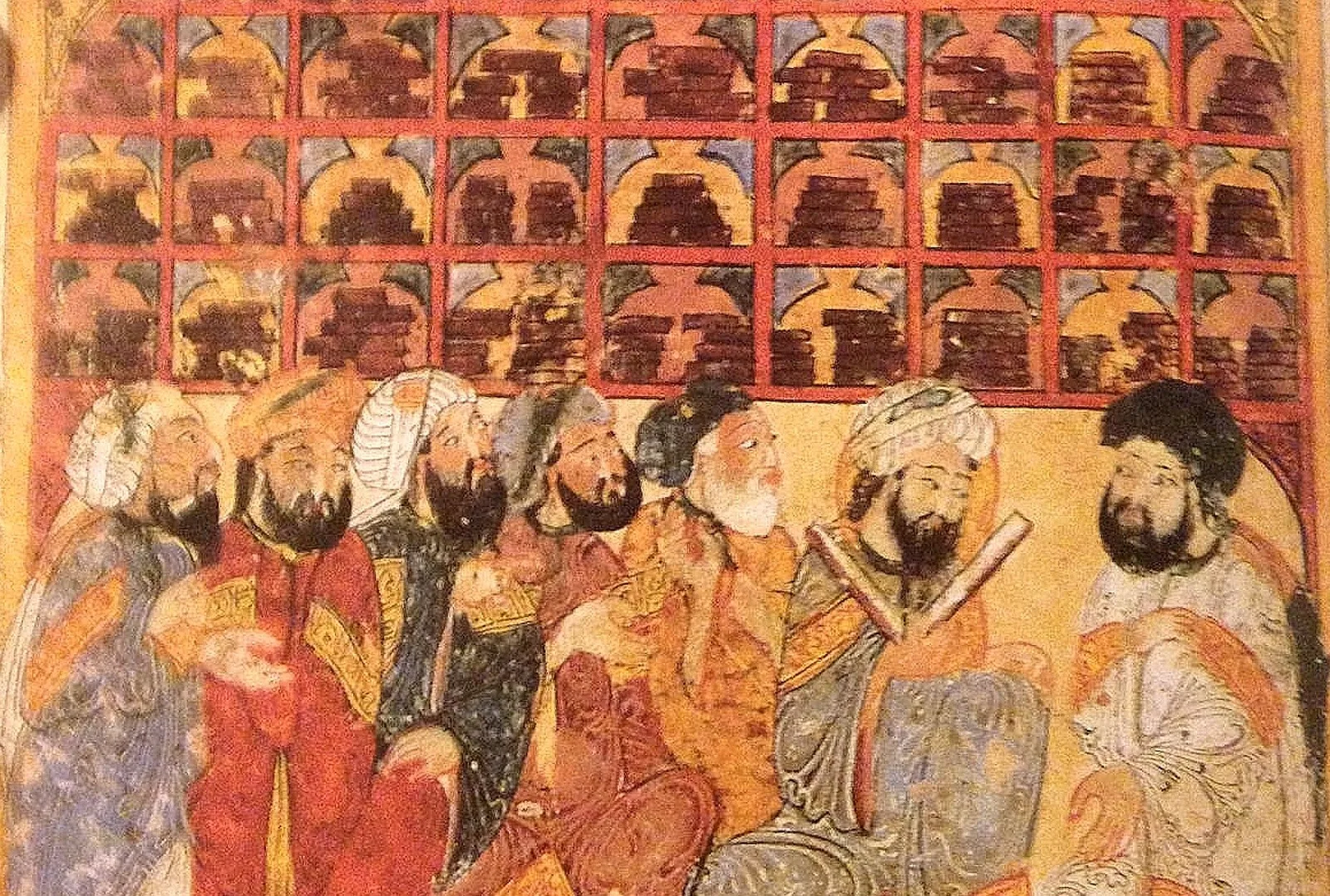
Papermaking reached the Islamic state in the eighth century. The first paper mill was built in the reign of Harun al-Rashid, and with it the markets of the warraqin, the copyists and booksellers, spread and books were copied on a large scale. This marked the beginning of the largest organized translation movement in premodern history… from Greek, Persian and Indian texts into Arabic, from the eighth century through the tenth [1][2].
Translation arose in response to the state’s vast expansion and its mingling with other peoples, to meet administrative, scientific and ideological needs. There was, for instance, the need to determine the direction of the Kaaba for prayer… and so scholars translated and studied the sciences of the Greeks and of other ancient civilizations. Or there were the advances in arithmetic needed to calculate zakat (the obligatory alms), land tax and the jizya, the poll tax levied on non-Muslims. Hunayn ibn Ishaq is reported to have gathered several copies of a manuscript and collated them against one another before translating, and he favored sense over the letter. Translators still argue over that same problem today, for civilizations never stop evolving, and their literature and science evolve with them.
After the golden ages, scholarly output became a matter of debate, and we reject the attempts to reduce it under labels such as “the dark ages.” That later period did see, if modestly, some original scholarship, shaped by changing political and economic conditions, and contact between East and West never ceased: from al-Andalus and the setting of its brilliant sun, through the Crusades… to the age of the greatest civilizational shock, at the hands of Napoleon, when the French expedition came and Egypt woke to the echo of cannon fire as horses were ridden into al-Azhar, Cairo’s great mosque and seat of learning. In the midst of these events appeared the dearest of guests and the most honored of friends… the modern printing press!
The Guest Who Was Late, Not Absent: The Printing Press
Christian communities had the honor of printing the first Arabic book: a Christian prayer book printed in Fano, Italy, in 1514. The first presses in the Arab East were likewise in Christian monasteries, at the monastery of Qozhaya in Lebanon [3].
Then came the Aleppo press, founded in 1706 by Athanasius Dabbas, and the press at al-Shuwayr on Mount Lebanon in the 1730s [3].
A theory has long circulated that the Ottomans forbade printing out of reverence for the religious text and a wish to protect it, and to safeguard the copyists’ trade. According to the conclusions of the scholar Kathryn Schwartz, there was no blanket ban [4].
The real turning point came when the states under the Ottoman umbrella began to win a measure of self-rule. In Egypt, the Bulaq Press appeared in 1820. Muhammad Ali’s reasons for his renaissance were anything but innocent, but they served scientific publishing and translation in the modern era. Then Rifa’a al-Tahtawi, newly returned from Europe, founded the School of Languages (Madrasat al-Alsun) in 1835 [5], and translation and printing became tools for building Egypt’s modern army. It began with printing the great classics of the Arabic heritage, so the literary publishing movement combined translation with literary revival. This was the same era in which Ahmed Shawqi led the return of the classical school in literature, and before him Mahmud Sami al-Barudi, God rest his soul, led the movement of revival and renewal.
The Press, Arabization and the Novel
Keeping pace with modern times and the growing density of information, a succession of newspapers and journals was founded in Egypt: al-Ahram (1875), al-Muqtataf (1876, founded in Beirut before it moved to Cairo) and al-Hilal (1892). The weight of publishing shifted from books to periodicals and newspapers, and the newspaper became the main ground for experiments in translation and for getting to know other cultures. It was also where publishers studied the behavior of their audience and decided, on that basis, how to make it pay. The press introduced general readers to new forms of translated literature, in the days when translation meant Arabization, recasting a foreign work in Arabic dress: Molière’s plays, for instance, in their earliest translations by Muhammad Uthman Jalal [19].
The same was true of Mustafa Lutfi al-Manfaluti, who, as is well known, translated for meaning, since he had little French [20]. From the womb of this free space other literary forms were born, the novel among them… before a system of intellectual and literary property rights was established later on. Yet another form of intellectual colonization appeared with the foreign schools in Egypt; the American University in Cairo (1919) took the lion’s share of it, followed by the American Research Center in Egypt in 1948.
The State, Censorship and Book Fairs (1950–2000)
In the twentieth century, as socialist leanings spread and countries won independence, whether from colonial rule or from the regimes that came before, the state became the largest publisher in a number of Arab countries. Landmarks of the period include the Committee for Authorship, Translation and Publication in Cairo (1914), the General Egyptian Book Organization, series such as Alam al-Ma’rifa (“The World of Knowledge”) in Kuwait (1978), and the rise of Beirut as the capital of free publishing from the 1950s to the 1970s, before the civil war weakened it. At the same time, censorship and confiscation remained tools close at hand, and distribution across Arab borders remained an unsolved problem: a publisher produces a book in one country and cannot reach readers in another. The answer took the form of book fairs, which became the main channel of distribution rather than mere cultural exchange. The Cairo International Book Fair was launched in 1969 and reached its fifty-seventh edition in 2026, according to the Egyptian press [6].
The Rise of Translation Institutions, and the Urgent Need for Them
The Arab Human Development Report 2003 put shocking figures on the table: as it is usually cited, the Arab countries together translate about 330 books a year, roughly one fifth of what Greece alone translates [7]. Other sources offer further evidence about the share of scientific translation and of other kinds. Nor are we among those who weep over the fate of scientific translation, say. There was a time in Egyptian and Arab history when the excellent books of the Russian publisher Mir flourished, in science, engineering and other fields, in masterful translations that have never been matched; then, swiftly, they collapsed along with the Soviet Union. Speaking of the Soviet Union: the end of the Cold War saw the rise of research institutions devoted to studying the ideologies of peoples and their intellectual, social and political ways… and the spread of foreign funding, as more than one writer of that generation has recorded, such as the family-planning campaigns of USAID. Egypt saw waves of campaigns of this kind after the Camp David Accords of 1978, when it became the second-largest recipient of American aid after Israel. Before that, in the 1960s, it had hosted branches of private foundations such as Ford and Rockefeller… as several other countries had before it. It would be naive to believe that these outside movements came with good intentions; they always have the capacity to go off-script, to abandon scientific pragmatism and to work toward less than noble ends. And it is no secret that they needed linguistic localization and rigorous translation as weapons, to understand the other more deeply than ever before.
The response to this crisis did not rest entirely on individual initiative. It extended to the founding of cultural and research institutions and projects that took on the production of knowledge, its transfer and the direction of its circulation in the region. In Egypt, the National Center for Translation was founded in 1995; then came the Arab Organization for Translation in Beirut in 2003, the Kalima project in Abu Dhabi in 2007, the Sheikh Hamad Award for Translation and International Understanding in Qatar in 2015, and, most recently, the Literature, Publishing and Translation Commission in Saudi Arabia [8]. Nor is the translation movement limited any longer to bringing knowledge into Arabic: some initiatives have turned to exporting Arabic literature into other languages. The Abu Dhabi Arabic Language Centre, for one, announced 14 translation and publishing partnerships at the 2026 Frankfurt Book Fair [9].
But these institutions cannot be seen as a merely neutral cultural response. The rise of modern research and cultural institutions in the Middle East coincided with the growing role of foreign funding in shaping the spheres of knowledge and media, and research centers, translation bodies and publishers became one of the channels through which it is possible to influence the topics raised, the ideas in circulation and the picture the public forms of regional and international issues. Influence over societies is not limited to military or economic power; it extends to controlling the flow of information and deciding what is translated and published, and what wins funding and reach. Steven Simon, the former director for Middle East and North Africa affairs at the US National Security Council under Obama, points in his book Grand Delusion: The Rise and Fall of American Ambition in the Middle East to the role of Gulf funding in rescuing the Middle East Institute, describing it as the first Emirati acquisition of an American think tank [10]. A dangerous precedent, would that my people knew.
The Grand Promises of Digital Publishing
I would argue that human beings are dreamers by nature, rich in imagination, and that this nature has carried them through life’s storms to a shore of achievement and mastery where imagination became reality. Yet imagination can also run wild, emboldening us to wish for and demand what the hand of fate will never grant. The expectation that some boom in digital markets will wipe out traditional markets and paper books altogether is perhaps one such wish.
In reality, digitization and globalization have made it easier for different worlds of knowledge to connect, and have even opened new digital markets, web novels among them. Amazon went further and tried to dominate them by building an e-reader with an e-ink screen. Yet all of these have remained different roads flowing into the one meeting place of knowledge.
Arabic digitization began with the heritage before the contemporary: libraries such as al-Shamela and al-Warraq made thousands of classical texts searchable, institutions such as Hindawi made books available for free, and platforms for buying and reading books appeared, followed by audiobooks. Meanwhile, the problems of Arabic script in digital form (letter joining, bidirectional text and fonts) have remained a persistent technical obstacle. As for the commercial market for Arabic e-books, my estimate is that it is still small relative to the potential readership, because of rampant piracy on Telegram and Facebook, payment difficulties and weak distribution systems. That is my own estimate, not a documented figure.
More important, digitization has brought back the old dilemma in a new form. When the cost of publishing fell until it was almost free, the question was no longer “Who can publish?” but “Who deserves to be read, and who can vouch that this text was written by the person who claims it?” What guarantees quality amid a heap of mediocrity that stretches for gigabytes as far as the eye can see?
Publishing in the Jaws of AI
In February 2023, only months after ChatGPT was launched, Reuters, as reported by the newspaper Al Khaleej, counted more than two hundred e-books on Amazon that had been written with the tool’s help or entirely by it, to the point that a new genre emerged: books about using ChatGPT, written by ChatGPT itself [11]. We, too, imported this absurd trend, along with all the other phenomena we import, and one of the first incidents came at the 2026 Cairo Book Fair:
At the fair’s 57th edition, news sites and social media users circulated images of pages from novels that contained ChatGPT’s replies addressed to the “author” about how to build the plot and develop the characters. In a novel titled Ruh and Iyad, the tool’s reply to the writer’s prompt appeared on the page, promising to continue the narrative with a focus on the developing relationship between the two protagonists; the text then jumps straight to a new line of narration, which shows that the writer forgot to delete the exchange from the draft [12][13][14]. Some social media users called it a “cultural scandal,” while others argued that using such tools is normal and that the deception lies in passing off generated text as human creativity [15].
The affair has stirred a wide debate with no end in sight, especially after statements from accomplished writers such as the Nobel laureate Olga Tokarczuk, who said she uses an advanced AI model to expand her ideas, then later clarified that she does not use it to write her texts, only for preliminary research [16][17].
The publishers’ position. Mohamed Rashad, president of the Arab Publishers Association, said that those who use AI in their writing may not disclose it, and that the covers of books and novels have already been designed with AI [6].
In some of our tendencies, we really are trying to commodify literature and art, turning a specialized profession into an open commons where anyone can write an entire book, or make a cover for their novel, at the push of a button.
What strikes me most is that this incident exposes an editorial failure before it exposes a technological danger. The text appeared as it did because nobody read it before it went to print: not the author, not an editor, not a publisher. This connects to an old structure in Arab publishing: many titles come out without any real editing, some of them at the author’s own expense. What should worry us is not the writer who forgot to delete the exchange but the one who deleted it. The exposed cases are the worst-executed ones; more telling than the scandal is what we do not see.
Western publishing, for example, is not limited to correcting grammar and spelling. It begins by reviewing the content itself, its idea and structure, the order of the chapters and the coherence of the argument or plot, then moves on to improving the style and wording, the choice of words and the clarity of sentences, then to checking grammar and punctuation and standardizing terminology, and finally to proofreading the final version after it has been designed and before it goes to print. These tasks are usually divided among specialized editors, such as the developmental editor, the line editor, the copyeditor and the proofreader. The editor is thus seen not merely as a corrector of language but as a professional partner in developing the work, one who helps the author improve it without taking the author’s place or confiscating the author’s voice and style.
In translation, the picture is more nuanced. Modern tools have markedly improved the quality of machine translation for Arabic, but the pressure they exert falls first on commercial and technical translation, not on literature. The more immediate danger is unreviewed machine translations entering the book market the way these novels did: without review and without disclosure. Writing in Al Majalla in September 2026, Osama Esber took up the question in a wider frame, asking about the future of writing and translation together rather than only whether a machine can write a novel [18].
In Closing: A Last Word
Human progress in the mechanics of printing and publishing made knowledge easier to circulate; then AI made writing itself cheaper, not to mention the knowledge and tools it can reach. Through it all, the question of responsibility, on which review depends, has stayed with us… Who reviewed the text? Gently, then, gently with the reader. And the most important thing we should seek to learn at this moment is this: what mechanism must we build for disclosing whether or not AI was used?
Read also: The future of translation and AI: who pays for quality, and who pays for speed?
Sources
- Jonathan Bloom, Paper Before Print (Yale University Press, 2001).
- Dimitri Gutas, Greek Thought, Arabic Culture (Routledge, 1998).
- Ami Ayalon, The Arabic Print Revolution (Cambridge University Press, 2016); and Geoffrey Roper’s studies of Arabic printing.
- Kathryn A. Schwartz, “Did Ottoman Sultans Ban Print?”, Book History 20 (2017).
- Albert Hourani, Arabic Thought in the Liberal Age (1962); and studies of Arabization during the Nahda, the Arab cultural renaissance.
- “AI novels: head of the Publishers Association reveals a shocking surprise about the 2026 Book Fair” (in Arabic), Egypt Telegraph (egypttelegraph.com, article no. 214379).
- UNDP, Arab Human Development Report 2003: Building a Knowledge Society.
- Official websites of the National Center for Translation (Egypt), the Arab Organization for Translation, the Kalima project and the Sheikh Hamad Award for Translation.
- “Abu Dhabi Arabic Language Centre unveils 14 translation and publishing partnerships at the 2026 Frankfurt Book Fair” (in Arabic), Al Ittihad, 6 October 2026 (aletihad.ae).
- Steven Simon, Grand Delusion: The Rise and Fall of American Ambition in the Middle East (New York: Penguin Press, 2023).
- “ChatGPT launches a boom in AI-written e-books on Amazon” (in Arabic), Al Khaleej, 21 February 2023 (alkhaleej.ae), citing Reuters.
- “AI scandal rocks the Cairo International Book Fair” (in Arabic), Al Jarida, Kuwait.
- “A shocking scandal at the Cairo International Book Fair, starring ChatGPT” (in Arabic), Elaph, February 2026.
- “Novels written by AI spark a wide debate at the Cairo Book Fair” (in Arabic), Al-Adabia, 5 February 2026.
- “ChatGPT on the shelves: a cultural scandal at the Cairo Book Fair” (in Arabic), Erem News (eremnews.com); and the OECD.AI report on the incident.
- “Nobel Laureate Says She Uses AI to Research Books”, Kirkus Reviews.
- “A Nobel Prize-winning author admitted she uses AI. What’s the literary world coming to?”, The Boston Globe, 21 May 2026.
- Osama Esber, article on AI, writing and translation (in Arabic), Al Majalla, 5 September 2026 (majalla.com).
- “Uthman Jalal” (in Arabic), Arabica, the Arabic encyclopedia of the Doha Institute for Graduate Studies.
- Muhammad Harb, “Al-Manfaluti’s lesson” (in Arabic), Al-Qafilah magazine, 16 July 2019.
Comments (0)