To save you time, I have summarized the key points, in order.
The short version
If I had to summarize the summary itself, I would say that two questions, responsibility and compounding error, are the strongest arguments against any claim that a field is dead. Who translated this contract? And who will bear the cost of the mistake? As for compounding error, it works like a compounding disaster, especially when you rely on probabilistic systems, however capable they become. We are betting on a difficult future, but one that, God willing, opens out in the end onto many safe opportunities. As the pre-Islamic poet Tarafa ibn al-Abd put it:
The days will show you what you never knew, / and bring you news by one you never sent.
And here is the summary itself, for anyone short on time:
- The market doesn’t split into “clients who want AI” and “clients who want quality.” The decision follows the text’s purpose, the cost of an error, and whether the reader can spot one. The same organization may accept a machine draft for one manuscript and insist on human review for a book or a contract, because there the cost of an error is high, and it raises the question: who will be held responsible?
- Quality means fitness for purpose, and it comes in several levels. The difference that matters to us is the one between a “less polished translation” and a “wrong translation.” The phrase “human quality” may mean one thing to the client and something else to the buyer, and translations by language models fall under this same classification. So before anyone talks about the fashionable “death of the field” (any field, for that matter), they need to compare it on every front. As for gut feeling, we leave that to Fadl Shaker and Wael Jassar, the Arab world’s great crooners of heartbreak; no serious judgment should be built on it.
- The biggest risk is not clumsy prose but an error that looks right, or passes itself off as correct: a dropped negation, a changed quantity, the wrong sense of a word with several meanings, or a literary tone flattened out. Fluency is no proof of fidelity.
- A long context does not mean consistency. The model has no memory between requests; large context windows don’t guarantee good use of what is in them; and omission and repetition errors grow with length. The fix lies in the system around the model (the glossary, the translation memory, how the project is split, consistency checks), not in the size of the window alone. That takes the subject beyond translation and organizational workflow to the edge of software engineering, which is a dilemma of its own.
- The model’s cost is marginal next to the cost of review. For a 75,000-word book, the model costs between $0.14 and $14.25, while review takes roughly 94 to 250 hours depending on the reviewer’s speed (on assumptions stated where the figures appear). So the question is: which model cuts review hours and serious errors? And I don’t expect model costs to come down in the near future; the machinery that goes by the name of artificial intelligence has its limits.
- Tools differ in their pricing unit before they differ in price: an individual license, a seat (better suited to small teams of five people or fewer), a word allowance, or AI credit. You may be surprised by what a human translator costs compared with AI, for example, and the former is more flexible than the latter. We have gathered the figures in a table of equivalent annual costs for individual tools. AI has enormous marketing pull, and some people treat it like Aladdin’s genie. That is pure illusion.
- Before you buy, try a difficult chapter: use the eight test sentences given here, test OCR separately from translation, export the file to the publishing software you actually use, and ask about the data policy.
- Translation isn’t dying; it’s changing. “Death” is a claim the evidence doesn’t support, but prices, volumes and where the value goes are clearly shifting between sectors, and the shift is happening across the whole planet. So, my fellow translator, drop the victim narrative; it won’t do you any good. Instead, explore the limits of what you can achieve in the new world. The ceiling on what is possible is astonishing.
- Choose by use case: Tarjum is designed for English–Arabic books, from manuscript to print, and is worth trying on a chapter; the same goes for large-scale localization, and it can work alongside other tools. We also offer custom solutions for companies, research institutions and others, but we are fully transparent with translators about the tool’s limits, as this article sets out.
Personally, I dislike narratives that prey on people’s well-being. I came to see how this negative narrative works while reading an article by Sahil Bloom: negative headlines raise click-through rates by 2.3%. Click-through rates, in turn, raise profits (indirectly, perhaps, but effectively), and everyone is after profit. As fate would have it, AI’s progress caught the public’s attention in the form of text, ever since ChatGPT appeared, so some may have written translation off as collateral damage. But however tempting it is to declare translation dead, the claim doesn’t hold up, and it has no right to.
The translation market doesn’t divide into a client who wants AI and a client who wants quality. The same organization may use a model to draft something for internal use, then ask for human review before publishing it, whether it is a book, a contract or marketing material. What decides the matter is the text’s purpose, the risk of error, and whether the reader can spot an error. So the useful question isn’t “Does the client trust AI?” but who uses it, for what, and with what level of review?
The 2026 European Language Industry Survey report gives a picture of one side of this shift. The survey drew 1,058 industry professionals from 45 countries, and 63% of freelance translators said they use machine or generative translation. That use was split roughly evenly between editing drafts prepared by the client and tools translators chose to use on their own initiative. In freelancers’ answers, post-editing requests made up no more than 15% of work from companies outside the translation industry and from public bodies, against 53% of work passed on by large language service companies.
Language service companies said that 54% of the work they outsource involves post-editing. So the market doesn’t move to a single beat: the workflow varies with who is ordering the translation. The report’s limitation is that it mainly represents the European market, small and mid-sized translation companies, and freelancers. It shows one side of the shift; what remains is to study how the translation market has changed since large language models arrived.17
End consumers paint a different picture. In a 2020 study by CSA Research of 8,709 consumers in 29 countries, 76% preferred product information in their own language, 40% said they would not buy from websites in another language, 66% reported using online machine translation, and 65% preferred content in their language even when its quality was poor. In other words, having content in the reader’s language can come before linguistic polish in a purchase decision; it doesn’t mean readers accept errors. The study predates the spread of generative models and measures stated preferences in e-commerce, not the behavior of Arabic readers or the quality of AI.18
So what matters to buyers isn’t getting “the highest quality” but pinning down the catastrophic error: a translator who hands over an internal draft that still needs editing; a publisher or author who rejects a smooth text that changes the author’s voice; a legal department that rejects a discrepancy in a single clause. These are not small things. They are disasters.
What is actually changing in translation?
The translation market grew from $50 billion in 2018 to $71.7 billion in 2024, an average of about 6.2% a year. After that, Nimdzi (a global market research firm) put the industry at $72.6 billion in 2025 and $73.4 billion in 2026, which is growth of less than 1%.
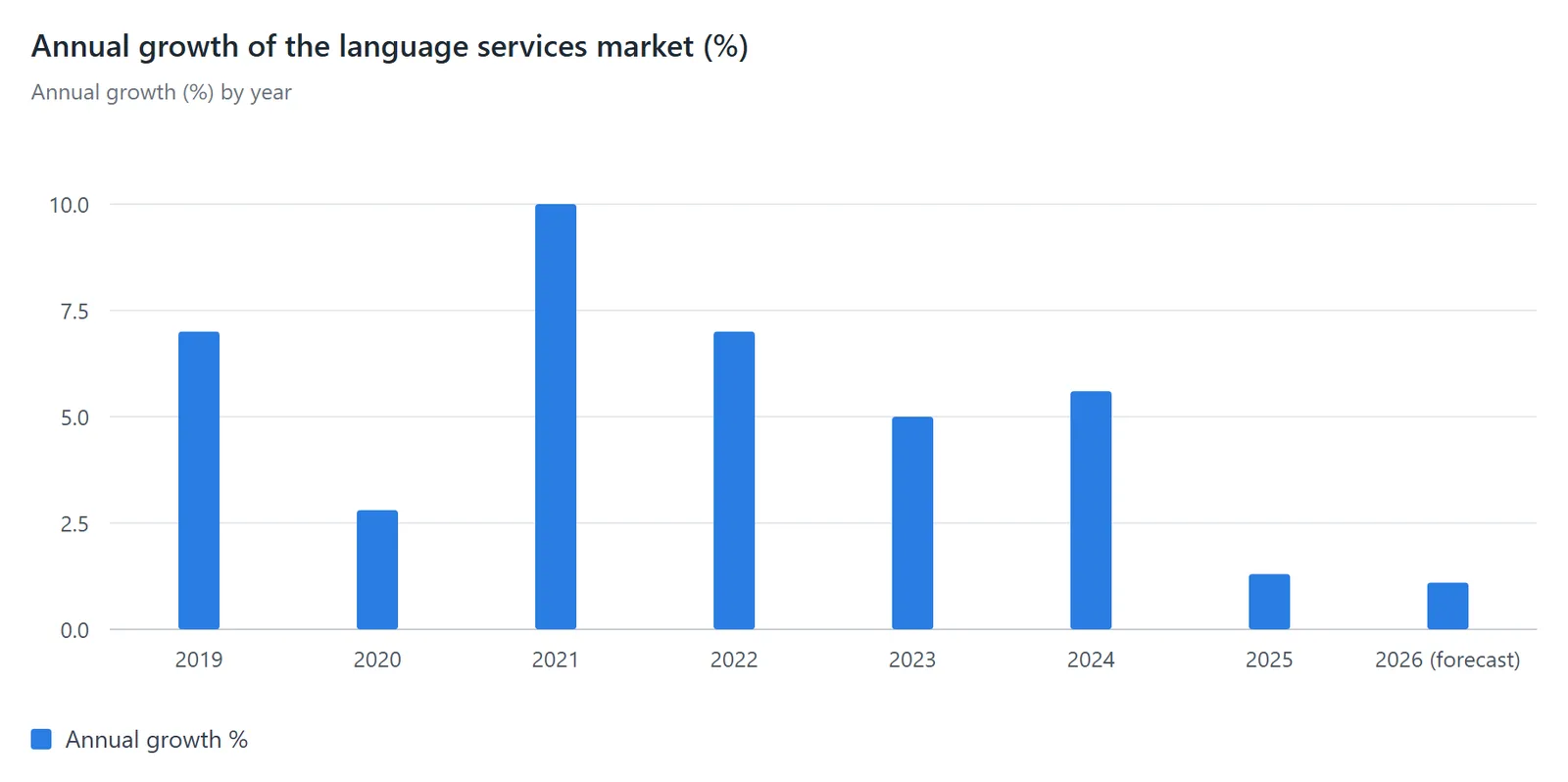
Demand for writing and translation fell 20–50% short of expectations, with small projects taking the lion’s share of the drop, and demand for European languages fell by 23%.
What stands out is that the market itself did not collapse; it was only slightly affected. What changed radically is the nature of the market and of the demand for it.
Demand grew in fields that complement AI or are untouched by it, while demand for beginners fell, even within the complementary fields.
Before generative models, a translator would enter a sentence into a CAT editor (computer-assisted translation tools, the best known being Trados), draw on a translation memory or an MT engine, then review the output. Today, language models can summarize a chapter, propose a rendering of it, explain a sentence, produce a first draft that reads more naturally than the output of some traditional systems, and make use of notes and longer context. This widens what a translator can get done in a short time, and it is sharply restructuring the translator’s job itself, perhaps in a way without precedent in history. But it doesn’t change who bears responsibility: a text that will be published needs a clear human decision, especially when a small difference changes the meaning or tone, or carries legal or medical liability, for example.
To start, we’d like to clarify the field’s best-known terms, which we have gathered in the following table.1 2
Term | What it is |
|---|---|
CAT (computer-assisted translation) | An organized translation workspace: it splits the text into segments, shows source and target together, recalls earlier translations, highlights terms, and allows comments, checks and review. It doesn’t necessarily translate anything itself. |
Translation memory (TM) | A database that stores segments translated and approved earlier, and suggests them when an identical or similar segment comes up again. |
Termbase (glossary) | A list of approved equivalents for names and terms, usually with a definition and context. |
MT | Machine translation: technology that produces translations automatically. It may be a separate engine or a function inside a CAT tool. |
LLM | Large language model: a generative model that proposes or rewrites text according to the instructions and context sent to it. |
TMS | Translation management system: broader than an editor, it assigns files, tasks and reviewers and tracks progress. |
Using AI inside computer-assisted translation tools (CAT tools) never means doing without the human translator; human judgment and the human touch remain decisive in every detail of the work, to ensure accuracy and accountability. The European Language Industry Survey (ELIS), an annual report that canvasses experts and professionals in the sector, shows the changes under way in the market, and the higher bar for entry-level translators is a natural result of changing working methods and requirements. As for the claim that “translation is dead,” it is false, and neither the evidence nor actual practice supports it.
The software industry has put up far more resistance, and more stubbornly, than the translation and writing market, despite AI’s clearer and more visible impact on software, and despite software being many times larger. In translation, it is as if replacement and the death of the field had become a foregone conclusion.
What to expect in the near term is not a move from human translation to machine translation, but a move of part of the time from drafting to preparing instructions and context, choosing language resources, checking suggestions, and documenting decisions. A faster draft doesn’t mean the whole project takes less time: if the text needs deeper review or repeated fixes, the work moves from writing to correction instead of disappearing. To put it plainly, with no hedging: this is our stated policy at Tarjum. We work to push production toward decision-making and to cut manual work as far as possible, whether in translation, editing or formatting.
To clarify some of the problems in the market today, we have decided to divide clients into two types:
Who turns to AI, and why?
It is more accurate to divide clients by task and risk than by general assumptions about age or sector. The same client may use machine translation to understand an internal message, then buy human editing for its public website. A novel’s publisher may start from a machine draft to cut turnaround time, yet refuse to publish it without literary editing. And a large organization may use AI for its internal archive while keeping legal or medical content off that track.
Those who want speed and coverage before polish
This need shows up with large, repetitive or low-risk content: an internal archive, first-pass descriptions of large product ranges, non-sensitive service messages, or material someone needs to understand before deciding whether to translate it in full. This client cares about getting more content available in another language, quickly, and may accept middling prose as long as it is understandable and carries no substantive error; checking a sample may be enough, instead of editing every word. But “for internal use” describes where the text will be read, not how serious its consequences are: an internal message may contain operating instructions, staff information or a business decision. So the buyer first decides what may be sent to an external model, what needs review, and what an error would cost.
This kind of low-quality translation existed long before AI in its current form. A company as big as Amazon, opening in new markets such as the Gulf states and Egypt, would not hire human translators to translate thousands of products. It relied on post-editing systems instead.
Those who build AI into the translation chain
This group includes large translation companies and localization departments that handle huge volumes of files. They usually don’t just run a model and ship the output; they fold the draft into a cycle that includes the translation memory, the termbase, the translator or editor, and quality controls. ELIS (European Language Industry Survey) data show that post-editing requests are more common in work outsourced by large language service companies than in work coming from non-specialist clients or public administrations.17
That is why the same buyer can be pro-AI and a stickler for quality at the same time: they want a faster draft, and they want the vendor to take on review, consistency and compliance with the specifications. From the translator’s side, having a draft doesn’t mean the working time drops by the same proportion; the draft may need fixing, or checking of information that isn’t visible in the text. So both sides must agree that post-editing is not a quick read-through of the target text.
Those who buy published quality and accountability
When the text is a book that will carry an author’s name, a contract a party will rely on, a medical or government leaflet, or a marketing campaign that represents a brand, the cost of an error is higher. This client cares about accurate meaning, consistent names and terms, the voice of the author or the brand, and being able to know who reviewed the text and who approved it. They may use AI for a first draft, or for suggestions and comparing alternatives, but it should not be assumed that they want final machine output.
This division starts from the real consequences of use, not from survey results on sectors’ willingness to pay. The decision varies even within a single organization or sector: a publisher that is relaxed about a low-risk promotional piece with light editing may insist on the highest accuracy for the body of a book, and a tech company that relies on AI for internal help pages may require careful human review of every safety warning. Accordingly, the vendor makes a point of finding out the purpose, the target audience and the acceptable standard of the result, going beyond the simplistic question “human or machine translation?”
Those who want to understand right now
Individual readers use machine translation to catch the meaning of a foreign message, post or page. A first understanding may be worth more to them than literary, publishable prose, and they can ask for a rewording or a quick check if the text seems ambiguous. But relying on translation just to understand carries a particular risk: if the user doesn’t know the source language, they may be unable to spot an error. So accuracy still matters even when there is no intention to publish, and the level of checking must rise whenever the text concerns health, money, rights or safety.
Is quality still in demand in the age of language models?
Yes, but the market doesn’t always ask for the highest possible quality. Clients weigh turnaround, cost, coverage, privacy, accuracy of meaning, and style. They may accept a limited drop in fluency to get the content in their own language, but they won’t necessarily accept changed numbers, a dropped negation or invented information. This is the difference between “low-quality translation” and “wrong translation”; confusing the two empties the phrase “acceptable quality” of any practical meaning.
ELIS 2026 also reveals a gap between what vendors imagine and what some buyers say. Language service companies and freelance translators believe their clients expect post-editing to deliver quality close to pure human translation, while more than 30% of respondents in translation departments said they expect slightly lower quality. That doesn’t mean all buyers accept a lower standard, but it does mean the two sides may use the phrase “human quality” in two different senses. So before pricing, define which errors are unacceptable, and whether the job is to convey the meaning only or also to preserve style, terminology and cross-references across the book.17
People’s view of AI quality also changes with use. The report found that only 23% of freelance translators rated the quality of MT and language models as high or very high, against 40% in 2025, and it suggests that the effect of the fluency generative models brought is wearing off as experience grows. These are professional opinions, not a blind quality test, but they are a warning against relying on first impressions: smooth text does not add up to lasting trust once the errors have been reviewed.17
This is a problem built into AI and its translations: total confidence in the text, even when the input is wrong or, at times, ambiguous. Of course, its effect is fading as the technology develops, but it is still there, especially with classical texts or texts unfamiliar from its training data.
The effect shows up in prices. Some clients talk about “human quality” while buying post-editing at a lower rate. Reported average discounts on post-editing rates ranged from 13% (freelance translators) to 20% (translation departments) and 29% (language service companies working with external editors). These are average answers from different groups, not a global tariff or evidence of profit margins, but they don’t support the idea that all post-editing is priced at one large, uniform discount.17
The other catch is that efficiency gains don’t always go to the same party. Among respondents at language service companies, 59% saw a direct negative impact from AI, against 12% who saw a positive one. In a separate question on the effects of implementation, 58% of companies reported better productivity and efficiency and 38% lower costs, while 23% cited a negative effect, mainly lost business. These findings don’t necessarily contradict each other: a company may do the work faster and cut its internal costs, yet lose revenue if the client switches to doing the work itself or pushes prices down. The report doesn’t prove that this is the only cause; it shows that “AI raises productivity” does not automatically mean “AI improves the vendor’s position.”17
So quality is neither a demand that has died out nor a single thing in every case; it is fitness for purpose, ranging from a private first understanding to a published text its owner answers for. That is why, before work begins, the buyer should answer five questions: Who will read the text? Will it be published? What are the consequences of an error? What is required in style and terminology? And who reviews and approves it? Without these answers, the vendor sells speed as quality, or the buyer asks for literary quality under a contract that doesn’t cover the time needed to edit for it.
Where does AI fall short?
Even Aladdin’s genie was limited to three wishes. So where are the limits of the new digital genie?
1. The limits of context: what the model can do, and what the system around it does
A language model keeps no memory from one request to the next. All it knows about your book when it translates a segment is what was sent to it in that request; if a decision the team made in chapter three didn’t reach it, then for the model that decision doesn’t exist. The capacity of a single request is set by a context window, a ceiling on what is sent and generated, and output usually has a smaller ceiling of its own. Translation sometimes makes a text longer, so the output ceiling may run out before the end of the chapter.
So do bigger windows solve the problem? Not automatically. First, cost: in the basic Transformer architecture, memory and computation grow quadratically with sequence length. Algorithmic and hardware improvements have eased this, but it hasn’t gone away, which is why sending the whole book with every request is expensive and slow.19 Second, uneven use: a study by Liu et al. found that performance is often highest when the information needed sits at the beginning or the end of the input, and drops markedly when it sits in the middle, even in models designed for long context.19 Third, the gap between advertised and effective length: the RULER benchmark tested seventeen models, all claiming a context of 32K tokens or more, and only about half of them kept satisfactory performance at 32K, even though they scored almost perfectly on the simple “needle in a haystack” test.20 These are studies of 2023 and 2024 models; newer models do better, but the methodological lesson stands: advertised length is not effective length, so test it on your own text.
In translation specifically, an evaluation on book-length texts (SEGALE, 2025) showed that many open-weight models don’t actually translate at their advertised context length: under-translation and over-translation errors rise sharply as the input gets longer.21 In other words, the error doesn’t always take the form of clumsy prose: part of the text may be dropped or repeated. This matters for a book because a book’s consistency is a global property (names, terms, tone, cross-references), while the model generates text locally, one piece after another.
The practical fix isn’t necessarily a bigger window but a system around the model, known in the agent literature as a harness: code and data that decide what is sent to the model, what is stored, and what is checked. It splits the book into suitable segments, sends only the relevant glossary entries and terms, retrieves previously translated segments from the translation memory, keeps a sheet on the characters and style and a running summary of earlier chapters, then checks consistency across the whole book, and then a human reviews. Research supports this direction: in the Self-RAMT study, retrieving relevant distant context raised metric scores and terminology consistency, instead of loading the attention mechanism with a very long context.22
But the system eases the problem rather than eliminating it: retrieval may miss a relevant passage, a summary loses detail, and a glossary can’t capture an implicit decision such as irony or register. That is why the comparison in this article is between systems, not models: the model is replaceable, while a book’s consistency is achieved through the glossary, the memory, how the project is split, and the checks. Testing a hard chapter, and checking consistency across the whole book, remain preconditions for any promise of consistency.
2. A single word can change its meaning
The problem shows up with words that have several meanings. An Arabic word such as «العهد» (al-ʿahd) can mean a promise, a reign or an agreement, depending on context. The English verb “charge” can refer to an accusation, a cost, charging (a battery, say) or an attack. A model may pick a sense that is common but wrong for the scene. And the sentence may be grammatically sound, which makes the flaw hard to catch on a quick read.
A glossary helps fix a term when the concept is stable. But it must record context and definition, not a mechanical equivalent for every form of the word. Sometimes the same source term deliberately has different equivalents, and sometimes the difference should be kept rather than flattened. The right rule isn’t always “use the same translation everywhere” but “use one equivalent when the same concept comes back, and tell the senses apart when the concept differs.”
3. Fluency can hide omissions and additions
A model may produce a smooth English or Arabic sentence while dropping a qualifier, condensing an idea, or adding a logical link the source never made. Fluency is no proof of fidelity. In a book translation, the difference between “many people” and “all people” is a single word that changes the generalization, and a model may drop a negation, a tense or a conditional, then phrase the paragraph as if it all held together.
So review must not come down to a single question like “Does the translation look good?” The reviewer needs to compare source and target, check names, numbers, negations, pronouns and qualifiers, and then read the output in the context of the paragraph and the chapter. QA checks can catch measurable discrepancies, but a semantic omission may not trigger any automatic alert.
4. Literary tone is not a playground for synonyms
A model may smooth out a text that is deliberately strange, turn a short, decisive sentence into a long explanation, replace rhetorical repetition with synonyms, or make every character speak in the same voice. In a literary book, style is part of the meaning. Ambiguity may be intentional; turning it into one clear meaning can be a wrong editorial decision, not an “improvement.”
The team should decide what it wants to preserve: the narrator’s voice, sentence rhythm, register, repetition, or the oddness of a phrase. Then it should give the model examples and notes on what may and may not be changed. Even with the best instructions, the translator still has to review a literary text as a whole text, not as a sum of separate sentences. Context helps, but it doesn’t settle aesthetic choices.
5. Arabic and right-to-left text need real testing
In Arabic, punctuation, numbers, Latin script and links can get tangled together, and grammatical gender can change according to what a pronoun refers to. Diacritics (vowel marks) remove some ambiguity, but they force additional editorial decisions. An Arabic manuscript may contain names spelled more than one way, or words whose written forms are very close. It isn’t enough for a vendor to say it supports Arabic; you need to test text direction, how brackets display, headings, diacritics, numbers inside mixed text, and the final export file.
Tarjum’s public page shows an example comparing unedited machine output for an English passage about a table, and explains differences in noun gender, verb choice, and a dropped word indicating degree of brightness. It is an illustrative example from the company’s own site, not an independent test, but it shows the kind of error that slips through if the reviewer reads the Arabic on its own without checking it against the original.5
6. OCR can plant errors before the model even starts
When a project starts from scanned pages, optical character recognition can misread a letter’s dot, a hamza, a digit or a name. If the system translates wrongly extracted text, the machine output may look illogical, but the root of the problem may lie in the OCR. And if the error gets into the memory through a mistaken approval, it may recur elsewhere.
Test OCR separately from translation. Compare the extracted text with the image by hand on a difficult sample, then correct the source before passing it to the model. Also check chapter headings, footnotes, text inside images, and rare words. In an old book, proofreading may need someone who can read the script, not just feeding the image to a model and assuming the text is now correct.
7. The assistant is not a reference independent of its data
If you ask an assistant inside a translation tool for “the approved equivalent,” its answer depends on the information it can access. The glossary may be incomplete, the memory out of date, or the instructions generic. The assistant may also produce a confident explanation without showing its source. So the translator needs to see the reference or segment it relied on, and to be able to correct data that will be reused.
That doesn’t make the assistant useless. It can suggest alternatives, summarize where a term is used, or explain a difficult sentence. But this should be treated as support for analysis, not as a final verdict. The best question for an assistant is a specific one: “Which segments use this term?” or “What is the difference in meaning between these two suggestions in this context?” Then the translator reviews the results and makes the decision.
The cost of error: why a cheap draft isn’t enough
The cost of an error depends on when it is caught. If the translator notices a character’s name varying in chapter one, updating the glossary and the memory may be all it takes. If the editor finds it after the book is finished, the team may have to search every chapter, file and comment. And if it is discovered after layout, the fix may spread to the pages, the index, the footnotes and the e-book editions. These aren’t general financial estimates; they are work items that pile up the later a flaw is found.
There is also the cost of the error that isn’t obvious. A model may put out a convincing sentence that attributes a position to the wrong character or adds a judgment the author never made. The reviewer may need to go back to the original, to a specialist dictionary or to the historical context. In these cases, the model doesn’t shorten the research; it may add steps if its first suggestion pulls attention away from the real meaning.
Then there is the cost of “false alarms” in automated checks: if the software flags a missing term at every correct use, the team stops reading the alerts, and the important one gets lost among hundreds of notifications. Tune the QA rules to the type of book, measure the ratio of useful to useless alerts, and don’t take a large number of alerts as a sign of higher quality.
The MQM framework offers a way to classify translation issues such as accuracy, fluency, terminology and style, and to tie them to severity levels and to stated specifications. This is useful because “quality” is not a single verdict. A typo may be minor while a dropped negation is major; a tone may be acceptable in marketing content but unacceptable in a literary text. The framework recommends setting the specifications, then annotating issues by type and severity, then using the results for analysis and improvement.4
How is the AI bill calculated?
With application programming interfaces (APIs), usage isn’t counted by the number of words you see. Providers usually charge for units called tokens, on input and on output, at a price that varies from model to model. Input includes the system instructions, notes, glossary and earlier segments sent as context; output is the text generated. Every re-ask, second version or expansion of the context is an extra call. Arabic has a particularity here: an Arabic word usually uses more tokens than an English word, and the gap varies from model to model, so don’t turn a book’s page count into a bill with a fixed rule. Take a 1,000-word sample, count its tokens with the counting tool the provider offers, then multiply.
OpenAI’s official page gives an example of how price varies by model. When checked on 5 November 2026, GPT-6 Luna cost $0.10 per million input tokens and $0.50 per million output tokens, GPT-6 Sol $2 and $10, and GPT-6 Astra $10 and $50. The page also lists Batch API processing at a 50% discount on input and output for jobs run that way. These are API prices from one provider on a given date, not uniform market prices, and not evidence of which model any translation product uses.16
Nor should a chat app subscription be confused with API use: OpenAI’s page makes clear that API usage is billed separately from a ChatGPT subscription, and that use in the Playground is billed like the API. So any estimate of “what does AI cost?” starts by defining what is meant: the API directly, a subscription to a CAT platform, a plan that bundles some models into the package, or the vendor’s own usage units.16
On Tarjum’s pricing page, the company says that the models included in a plan carry no extra charge for normal use within the plan, while other models the user chooses are charged to a prepaid compute wallet. On Smartcat, plans use a Smartwords allowance within a workspace plan, instead of showing users the cost of each API call. In both cases, knowing the subscription fee isn’t enough to know the final bill; you need to know the usage cap, what counts toward it, what happens when you go over the limit, and whether retranslating uses up extra credit.6 12 13
The project cost equation
A book’s total cost can be broken down like this:
Project cost = platform subscription/license + model usage + OCR and file preparation + translation and review time + error fixing + formatting and layout + data migration or training.
This doesn’t mean every item will show up on one invoice: OCR may be included in the package, page design may be an outside service, the reviewer may be a member of the publisher’s team, and the model cost may be paid from platform credit. But if the items aren’t written out separately, you may end up comparing two prices that don’t cover the same work.
Get written answers to four questions before a trial. First, is usage counted by source words, target words, tokens or a proprietary credit? Second, do memory matches and repetitions use up credit in the same way? Third, is the chosen model included in the package, or does it need separate credit? Fourth, are human review, specialist proofreading or file reformatting included? The word “editing” may mean something different from a human translator approving every segment.
Where does the money go in a 75,000-word book?
The figures below are a calculation on stated assumptions, not market prices. We deliberately assumed high usage: 300,000 input tokens (the source text, then the instructions, glossary and context re-sent with each segment, then a second pass) and 225,000 output tokens (75,000 Arabic words at three tokens per word). The prices are the standard API prices given above.16
Model | Price per million: input, then output | Input (0.3 million) | Output (0.225 million) | Total |
|---|---|---|---|---|
GPT-6 Luna | $0.10, then $0.50 | $0.03 | $0.11 | $0.14 |
GPT-6 Sol | $2, then $10 | $0.60 | $2.25 | $2.85 |
GPT-6 Astra | $10, then $50 | $3.00 | $11.25 | $14.25 |
Review, by contrast, is measured in hours. If the editor reviews 300 words an hour (a text that needs close comparison with the original), the book needs 250 hours; at 500 words an hour, about 150 hours; at 800 words, about 94 hours. These are hypothetical speeds for the exercise, not market averages; measure your real speed on a trial chapter.
The upshot: the price gap between the cheapest and the most expensive model here is about $14, while review is estimated at 94 to 250 hours. If the pricier model saves just 10% of review hours, that is 9 to 25 hours, it covers the price difference as long as the reviewer’s hourly rate is above about $1.50. If it saves nothing, you have paid more for nothing. So the question isn’t “Which model is cheapest?” but “Which model cuts review hours and serious errors on a hard chapter of my book?”, and that is something you measure, not something you infer from a price list.
This calculation applies to those using the API directly. If you buy a plan from a platform, the bill follows the platform’s units and caps, as the paragraphs above explain.
A practical workflow for a book using AI and CAT
1. Prepare the source before requesting a translation
Make sure you have the rights to upload the text to the service. Keep a saved copy of the original file, and separate the translatable text from comments and material that shouldn’t be sent. If the source is an image, check the OCR by hand on a sample. Fix the file names, chapter names and language direction, and record the version of the text. If the source changes after translation starts, keep a log of which segments changed, so that an old translation isn’t reused without review.
2. Prepare a book brief
Before the system or the translator translates anything, prepare a short brief on the book: subject, time period, audience, main characters or concepts, register, and what must be preserved. Don’t just ask the model to “translate in a beautiful style.” Write rules that can be tested: don’t remove deliberate repetition, don’t add explanations, keep book titles in their original language in the bibliography, and use the approved equivalent for specified terms unless the meaning differs. Then have the translator review the brief rather than trust it automatically.
3. Build a small glossary that can be reviewed
Start with the names and terms you expect to recur. For each entry, record the source term, the preferred equivalent, a short definition, an example or a note on context, and a forbidden alternative where needed. Don’t try to load a huge dictionary without cleaning it first. Remove duplicates, set the direction of the two languages, and mark the domain. Decide who has the authority to accept changes, and how the rest of the team is notified when a term changes.
4. Produce the draft with limited, deliberate context
Split the text into suitable segments, and pass the model what it actually needs: the text, the instructions, the relevant terms, and the nearby context or a chapter summary. Don’t resend the whole book with every request unless there is a need; that can inflate the input and the cost. But don’t strip out the context that settles a pronoun or the tone. Choosing between longer and shorter context is a trade-off between possibly better understanding and higher cost and latency, not a rule that “the more we send, the better the result.”
5. Compare source and target before accepting
The reviewer should read the segment against the original, then review the sentences around it. They check that the ideas are complete, and check negations, numbers, names, connectives and tone. If the suggestion is correct, they confirm the segment. If they edit it, the final decision is saved to the translation memory. And if an alert concerns a missing term, they ask whether a new entry should be added, or whether this is a different use of an existing word.
6. Run automated checks after review
Check numbers, punctuation, tags, terminology and consistency. Don’t use “passed all checks” as the only criterion for publication; the team should know which checks are mandatory and which are advisory. When an unhelpful warning keeps recurring, adjust the rule or the glossary instead of letting everyone ignore it. When a warning is useful, document how it was fixed, so it comes up less often in future books.
7. Human review at chapter and book level
Segment review catches local errors; chapter review catches how a term recurs, or a change in the narrator’s voice; and whole-book review catches how characters or concepts develop over time. Don’t substitute one for another. You can review every segment and still miss a difference between the first and the last chapter if the editor doesn’t look at recurring vocabulary and decisions across the book.
8. Update the memory, and produce the output
Once the text is approved, send the correct units to the appropriate memory, not to a general, unclassified one. Save a copy of the glossary, and exchange files such as TMX, TBX or XLIFF where needed. Then test the export file in the editing or publishing software the team will use. XLIFF usually carries source and target pairs for the translatable segments, TMX exchanges memory data, and TBX exchanges terminology data; but having a standard format doesn’t guarantee that every note or custom setting will carry over between any two systems.3
Where does Tarjum fit into this future?
Tarjum builds its product around translating books between English and Arabic, from manuscript to a print-ready file. Its pages show tracks for the full book, the scanned book, team review, and printing and publishing, and describe preparing information about the author, the book, and the words that might trip up the translator; they also say that names and terms are handled consistently across chapters. This is the company’s own description of its product, not an independent measure of the quality of its results; the right test is to run a sample chapter through it and review the output with a human translator.5
Tarjum’s edge here is that it builds the workflow around the book, not around an isolated sentence: the translator moves from project to chapter to segment, draws on context, the glossary, the memory and the checks, and then reaches an editing and layout interface for the book. This can cut down switching between separate files for the source, terminology, review and formatting, for anyone working on an Arabic–English book who wants to manage the draft, its review and the preparation of the output in one track. This is an advantage in workflow fit for this use, not evidence that its translations are more accurate than Trados or memoQ, nor that it suits every language pair or every localization project.5
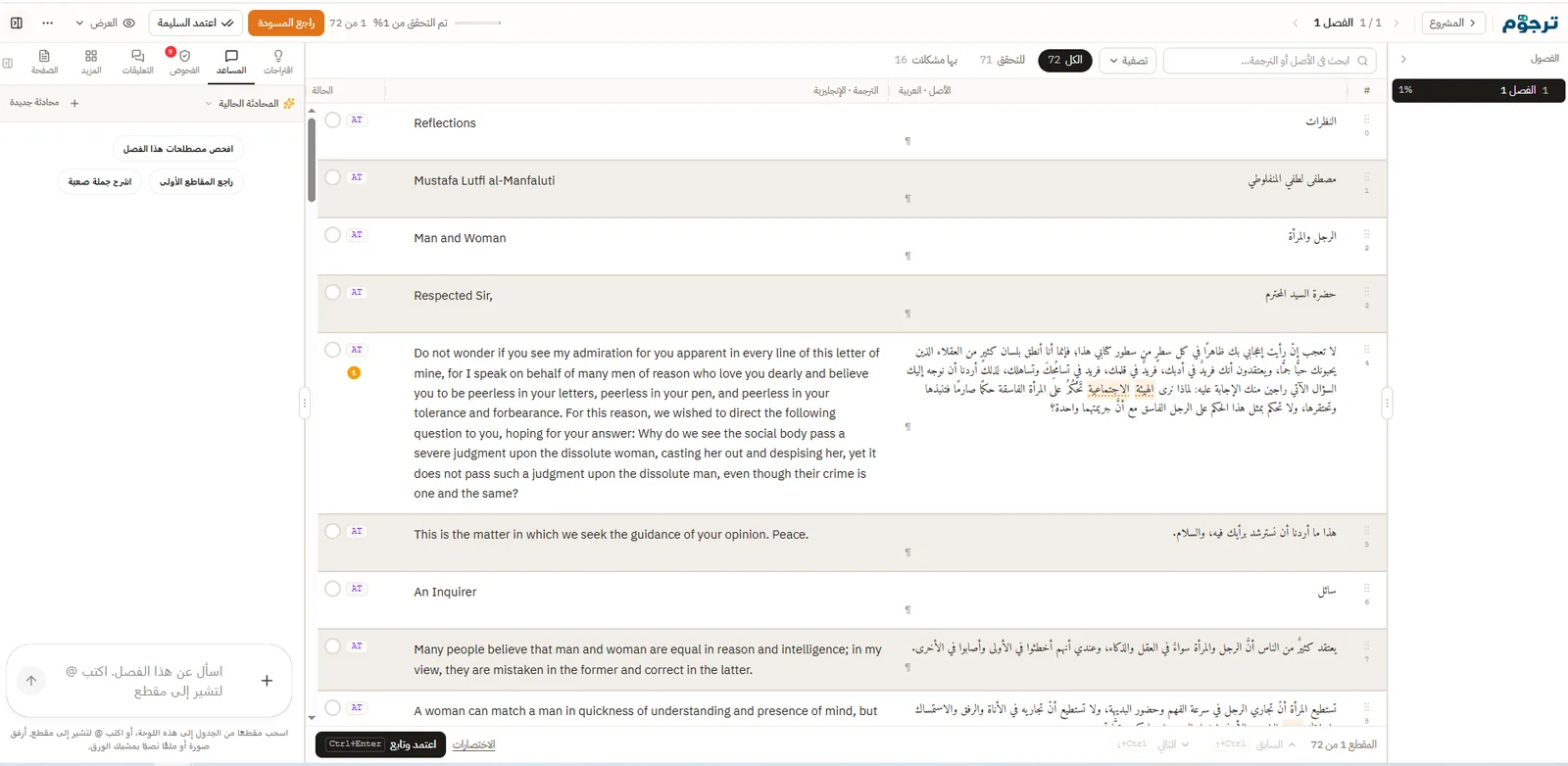
In the app, the picture starts with books, projects, language directions and progress statuses, and there is an option to import XLIFF. On the Memories page you can create a new memory or upload a TMX file, with a note that each book has its own memory and that confirmed segments from a finished book can be sent to a shared memory. The Marketplace offers dictionaries, translation engines and QA tools, with an option to import your own dictionary. This is a way of connecting translation resources to day-to-day work, not just a separate chat window.
Inside a chapter, the source and the target appear together, and you can confirm a segment, merge it with the previous one, search and filter by review status, or send a segment to the assistant. The checks panel shows terminology alerts with options to fix or rate. In the example opened, the alert showed that some source words had no matching approved term in the glossary; that is a gap in coverage, not an automatic verdict that the translator’s rendering is wrong, and the decision belongs to the translator: approve an equivalent, add it to the glossary, or leave it different to suit the context.
Tarjum also has a comparisons page that says it compares translation systems with human translation in a blind evaluation by professional translators. Having a comparison page doesn’t prove that one system beats another. For its results to count, its methodology should be published: Which texts? Which language pairs? Who were the evaluators? Was the output unedited or revised? How is an error defined? Was agreement between evaluators calculated? These questions determine whether the experiment can be repeated.
On its pricing page, Tarjum states that its plans include reading, research, the glossary, translation, editing, revision, layout and export files, while it describes human review as the client’s choice: done by their own team, or arranged with the company for a book it takes on with them. So don’t confuse “a machine draft with review tools” with “a fully human, signed-off translation service.” Ask about the human’s role in the quote before treating the price as the cost of the whole book.6
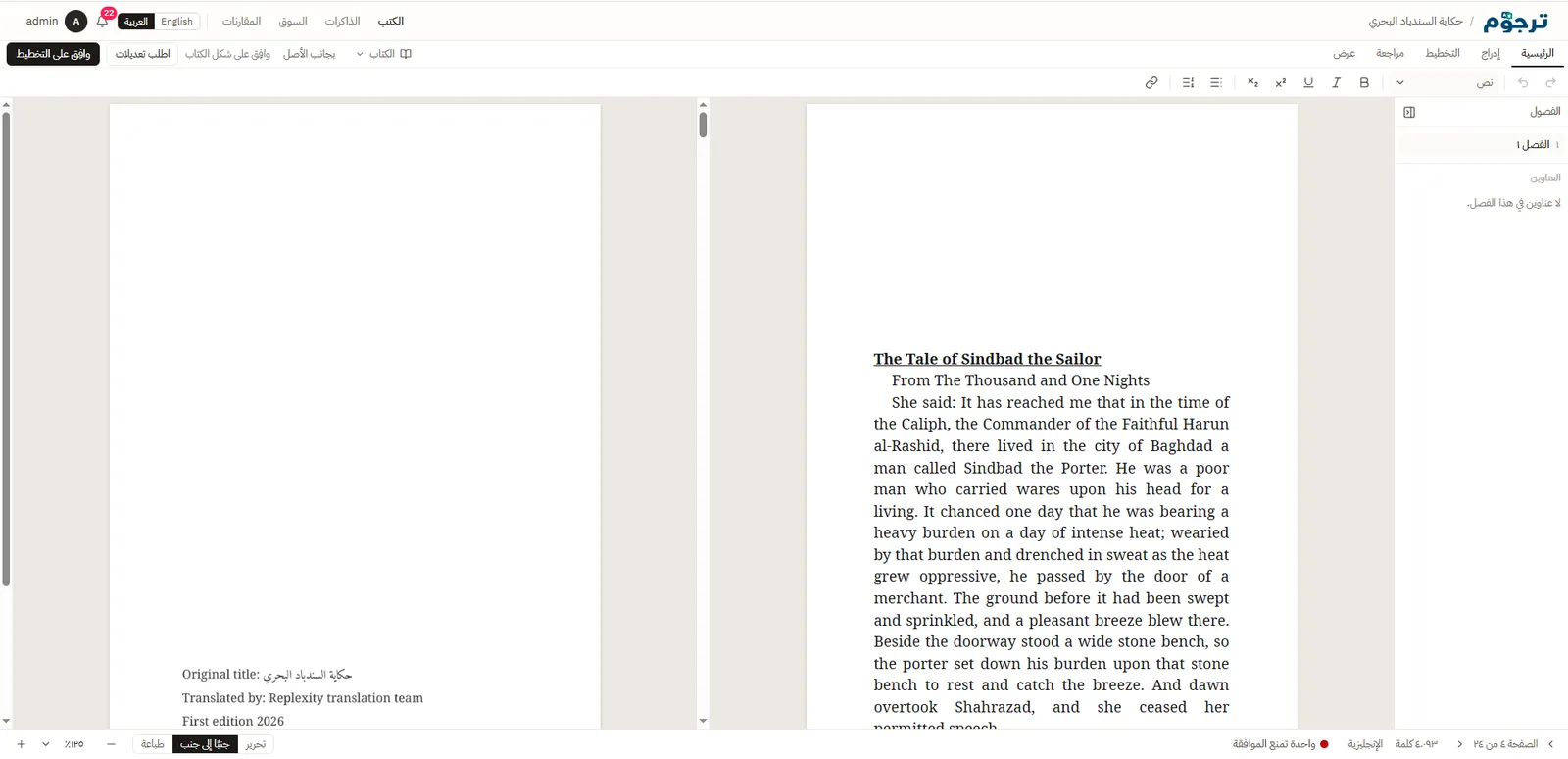
These images are separate examples from the tool’s interface and its output, not a complete sequence of the project’s stages; they introduce the interface and don’t prove the quality of the text, or that every segment went through the same review.
The final decision rests with the translator, or with the reviewer the publisher appoints. The chapter view shows source and translation side by side and lets you confirm segments, and the alerts draw attention to places worth checking; but a draft doesn’t become an approved text just because a model produced it or an automated check found no problem.
Comparing CAT tools in the age of AI
The comparison below looks at product scope and workflow, not translation accuracy or which tool is “best.” Vendors’ published information explains what each company sells, but it offers no independent, standardized test on a single Arabic book.
Product | What it offers in the workflow | Where AI and language resources sit | Best initial fit |
|---|---|---|---|
Tarjum | A track centered on the Arabic–English book, from segment review to page editing and the finished book | Book context, memory, glossary and checks; approving a segment stays with the translator or reviewer | Translating a book from English into Arabic, or the reverse, from manuscript to print; try it on a hard chapter before deciding, as it is not a general replacement for every CAT tool or TMS |
Trados Studio | A CAT editor for the professional translator; separate products exist for enterprise collaboration | TM, MultiTerm, QA checks and AI assistance, depending on the product and plan | A freelance translator or a team working in the RWS environment; compare Studio on an individual license, and Team as a different product |
memoQ Translator Pro / TMS | Translator Pro for individuals, TMS for team and enterprise projects | Translation memory, termbase and LiveDocs, plus QA checks and automation, depending on the product and plan | An individual who needs an editor, or a team that needs a TMS; don’t mix up the two licenses |
Phrase TMS | File and project management, CAT and cloud collaboration | TM, termbases, QA and MT/AI options within the platform | Localization teams and service providers, or an individual user on the Freelancer plan within the Phrase suite |
Smartcat | A browser-based editor within a broader TMS and localization platform | Memory, terminology, AI and checks; usage shows up in Smartwords units | A team that wants a workspace with multiple users; the cost is not a per-seat price |
Wordfast Pro / Anywhere | Pro is a standalone application; Anywhere is a browser-based service | TM, dictionaries, QA and MT integration, depending on the tool | A translator choosing between a desktop license and a browser service to suit their working setup |
The tools overlap on segments, memory, terminology and checks. The difference lies in the details: Is the system local or cloud-based? Is the team license separate? Is the project a book or a set of scattered files? How is the memory stored? Can a reviewer comment on a specific segment? What does the vendor charge when AI runs? Can the working files be exported? The phrase “supports AI” isn’t enough to know where the model sits in the workflow, or who pays for it.
Trados Studio is aimed at the professional translator, with a translation memory, a termbase, quality features and generative assistance, depending on the product. But Trados Team and the RWS enterprise platform are different products, covering centralized collaboration, roles and workflows; the price of the Team plan doesn’t stand for the price of Studio Freelance.7 8
memoQ likewise separates Translator Pro for individuals from TMS for team projects. Translator Pro can use a translation memory, a termbase, LiveDocs and QA checks. memoQ TMS, for its part, targets project setup, resources, real-time collaboration and reporting. The fact that both carry the same company name doesn’t make the TMS license a direct price for an individual translator.9 10
Phrase TMS is a cloud platform for managing files, jobs, memories and termbases, with a CAT editor, comments, approvals and checks. The Freelancer plan has a single TMS seat but includes a suite of Phrase products, while the larger plans scale to more seats and broader operations. Describe what a plan actually buys rather than reducing it to “a CAT price.”11
Smartcat puts a CAT editor inside a platform that covers collaboration, project management, language resources and AI options. Its pricing page shows workspace plans and uses Smartwords, and doesn’t show a price per translator. The help center may publish starting prices for higher plans while the sales page shows “Custom,” so always state which page a given figure comes from.12 13
Wordfast Pro is a standalone CAT application, and Wordfast Anywhere (WFA) is a browser-based service. Pro comes with a license valid for three years, according to the pricing page, while WFA is a subscription whose price varies with the term. Sharing and task-management features belong to WFA or to Wordfast servers, and shouldn’t automatically be attributed to the individual Pro application.14 15
The official pages don’t show that any of these tools matches Tarjum’s design around Arabic–English books, nor that Tarjum performs every function of an enterprise TMS. So the useful question is: which workflow suits this kind of book, and what needs a service outside the tool? Not: who lists more features on their marketing page?
Comparing prices: license, allowance, seat, or AI usage?
The prices below are as they appeared on the official pages on 5 November 2026, and they may have changed since. Prices are in US dollars or in the local currency as published, and a monthly figure doesn’t mean you can pay month to month; read the commitment term, the allowance, taxes and the license type.
Product and plan | Published price when checked | Pricing unit | Key note |
|---|---|---|---|
Tarjum Translator | EGP 990 / $19 a month; 120,000 words and 2 seats | Words-and-seats plan | Included models carry no extra charge, per the page; other models are paid from a compute wallet |
Tarjum Agency | EGP 4,100 / $79 a month; 500,000 words and 5 seats | Team plan with a word allowance | Check what you actually need and how many seats |
Tarjum Publisher | EGP 15,500 / $299 a month; 2.5 million words and 15 seats | Publisher plan with a word allowance | Don’t compare it with an individual license |
Tarjum Book Pack | EGP 988 / $19 for 100,000 words, valid for 365 days | One-off pack, not renewed | An option for a single book without a recurring monthly subscription |
Trados Studio Freelance | £34 a month on Annual Saver, £408 a year in total, with a 12-month commitment | Individual license | Excludes VAT; the Studio Professional price is not clear on the page as read |
Trados Team | From $1,688 a month, billed annually | Enterprise/volume product | Not the Studio price or a single-seat price; starts at three concurrent users, per the page |
memoQ Translator Pro | €396 a year or €44 a month; or $436 a year / $54 a month | Individual license | Check the currency and taxes for your country of purchase |
memoQ TMS Starter | From €2,750 or $3,025 a year, including one project manager and 5 linguist subscriptions | Team bundle | Higher plans need a quote; not the price of a single CAT seat |
Phrase Freelancer | $27 a month billed annually, with one TMS seat | Plan within the Phrase suite | The page as read doesn’t say whether taxes are included |
Phrase Professional | $525 a month billed annually, with unlimited TMS seats | Team/platform plan | Don’t compare it with a single translator’s price |
Smartcat Adapt | From $1,200 a year, with unlimited users and 100,000 Smartwords, per the page | Workspace plus usage | Not a per-user cost; higher plans are shown as Custom on the pricing page |
Wordfast Pro | $480 for a license valid for three years | Individual application license | Conditional discounts for some countries and for volume purchases |
Wordfast Anywhere | $1 for the introductory first month, then $9.90 a month | Browser service subscription | Not the Wordfast Pro price, nor a published team-seat price |
Price sources: Tarjum,6 Trados,7 8 memoQ,9 10 Phrase,11 Smartcat,12 13 Wordfast.14 15
The table doesn’t rank the tools from cheapest to most expensive, because the pricing units don’t match. Tarjum shows words, seats and a book plan; memoQ Translator Pro and Wordfast Pro are closer to individual licenses; Phrase and Smartcat sell workspace plans or product bundles; and an enterprise TMS may include a project manager, team members and workflows. Don’t work out a per-seat cost by dividing a team bundle’s price by the number of accounts unless the seats, allowance and features are spelled out that way.
For freelance translators comparing individual-license tools only, here are the same prices converted to an equivalent annual cost, in each product’s published currency (don’t compare across currencies without converting, and taxes are not counted):
Tool | Calculation | Equivalent annual cost | Note |
|---|---|---|---|
Tarjum Translator | $19 × 12 | $228 | Monthly price; includes an allowance of 120,000 words and two seats |
Trados Studio Freelance | £34 × 12 (Annual Saver) | £408 | 12-month commitment; excluding VAT |
memoQ Translator Pro (annual) | Direct annual price | €396 or $436 | The cheapest option for regular users |
memoQ Translator Pro (monthly) | €44 × 12 or $54 × 12 | €528 or $648 | About 33% more than annual in euros, and 49% more in dollars |
Phrase Freelancer | $27 × 12 (billed annually) | $324 | Includes a suite of Phrase products, not just an editor |
Wordfast Pro | $480 ÷ 3 years | $160 | Three-year license paid up front; conditional discounts |
Wordfast Anywhere | $9.90 × 12 | $118.80 | The first year is $109.90 because of the $1 introductory month |
The practical lesson: with memoQ, the flexible monthly option costs roughly a third to a half more than the annual one. If you are sure you’ll keep using it, the annual commitment is cheaper; if you’re just trying it out, pay for the flexibility knowingly.
Trados Studio Freelance at £34 a month is the Annual Saver option, paid annually (£408 in total), not the flexible monthly plan, and the prices exclude VAT. Trados Team, meanwhile, is a different product that starts at an enterprise price billed annually, and the price of Studio Professional wasn’t clearly shown on the pricing page we opened.7 8
memoQ offers Translator Pro on an annual and a monthly option, and the price gap between them is large (see the table above). TMS Starter, on the other hand, is an annual bundle that includes a project manager license and five linguist subscriptions, so a freelance translator should compare Translator Pro with tools for individuals, not with a team-management bundle.9 10
Phrase shows a monthly price for annual billing. The Freelancer plan includes more than a CAT editor, while Professional, with unlimited seats, is a broader team bundle. The pricing page we checked doesn’t settle whether taxes are included, so ask the vendor before you buy.11
Smartcat advertises Adapt from $1,200 a year, with unlimited users and a Smartwords allowance. The sales page presents the higher plans as “Custom,” while the help center lists annual starting prices for some of them; if you base your decision on a figure from the help center, treat it as a starting price, not a fixed price for every customer.12 13
Wordfast Pro is a three-year license, and Anywhere is a browser subscription with an introductory price for the first month; so don’t take the $1 first month as the permanent price, and don’t attribute the cloud service’s features to the standalone application.14 15
What a book costs when you buy a ready-made plan
Take a 75,000-word book. According to Tarjum, the Translator plan’s allowance of 120,000 words a month covers the nominal word count, and the 100,000-word Book Pack covers it arithmetically too. But before you settle on a cost, check whether words are counted on the source or the target, whether retranslating parts of the text or retrying uses up extra credit, what happens if the book needs a different model, and whether human review or reformatting images is charged separately. Tarjum’s page specifies some of these items and leaves the details of a particular book to the quote.6
If you use the API directly, don’t base the book’s cost on the word count alone. Try a representative chapter; record the input and output tokens, the number of retries and the review time; repeat the test on two models if you can; then work out the API cost on its own, and add the editor’s and reviewer’s hours and the file formatting on top. And if the platform bills in its own credit, such as Smartwords or a compute wallet, rely on the usage statement the platform provides, and don’t assume a direct conversion to API prices it hasn’t published.6 12 16
What should a translator or publisher test?
Take a chapter that contains dialogue, a term that recurs with two meanings, several names, mixed Arabic and English text, and a footnote or a table. Pick two paragraphs far apart that share a name or a term, to see whether the equivalent held steady across the distance between them. If the book is scanned, add a low-quality page. And don’t test only easy sentences, because they don’t reveal the failure points that matter.
A ready-made test sample
If you don’t have a chapter ready, here are eight English sentences that test the most damaging failure points. Run them through the tool and compare the output with the original; don’t stop at asking whether it reads like sound Arabic.
Sentence | The trap | What to check |
|---|---|---|
The tenant may not sublet the premises without written consent. | Here “may not” is a legal prohibition, not a possibility | That the meaning comes out as «لا يجوز» (“is not permitted”), not «قد لا يؤجّر» (“might not sublet”) |
Few members voted for the amendment. / A few members voted for it. | “Few” means hardly any; “a few” means some | That the two sentences are worded differently: «قلّة من» (“few, hardly any”) versus «بعض» (“some”) |
Not all the findings were confirmed. | Partial negation: some of the findings were not confirmed | That it doesn’t turn into «لم تتأكد أي نتيجة» (“no finding was confirmed”) |
The patient said the doctor had misread his chart, but she disagreed. | Grammatical gender is settled by a pronoun that comes after the noun | That “doctor” is rendered «الطبيبة» (the feminine form, “the woman doctor”), with verbs and pronouns agreeing |
The rate rose from 3.5% to 12% (Table 2, p. 45). | Numbers, parentheses and references inside Arabic text | That 3.5 stays as it is, and the parentheses, the table and the page reference stay in the right order |
The prosecutor dropped the charge, and the bank waived the charge on the late payment. | One word with two meanings in a single sentence | The first should be «تهمة» (“criminal charge”), the second «رسم» (“fee”) or «عمولة» (“commission”) |
She waited. She waited, and waited, and waited. | Deliberate literary repetition | That it isn’t replaced with synonyms or merged into one sentence |
Click Settings > Export, then name the file report_v2.docx. | Interface labels, menu paths and file names inside Arabic text | That the file name doesn’t change, and that neither the direction of the arrow nor the order of the path items is reversed |
Score each case on three levels, in the MQM manner: correct; a minor error that doesn’t change the meaning; or a major error that changes the meaning, the ruling or a number. Major errors are what matter to you: a tool that makes them in a small sample may repeat them across a whole book, so ask how the reviewer will catch them. Alongside the test, measure review time per 1,000 words; that is the figure you need for the cost calculation in the earlier section.
Test meaning before impressions
Ask a translator who knows the text to compare the source with the machine draft. Log omissions and additions, and changes to negation, pronouns, tense, terminology and tone. Don’t accept “the sentence sounds natural” as a sufficient score. If the translation comes out smooth but the relationship between characters has changed or a qualifier has been lost, the problem is fundamental, even if the reader finds no grammatical error.
Test translation memory on a recurring project
Load a set of previously approved segments. Check whether exact and fuzzy matches appear, whether the translator can reject them, and whether the system keeps the context of the decision. Then change one segment in the source, and see whether the system suggests outdated text that no longer fits. A useful translation memory cuts repeated work; an unclean one repeats the mistakes of the past.
Test the glossary, not just whether it exists
Create five entries, each with a definition and a note. Use each term once in its usual sense and once in a different context. Does the system highlight the difference? Does it let the translator explain why they departed from the approved term? Can the reviewer approve the new term and notify the team? If the interface only flags a missing term, without showing context or offering a way to document the exception, managing the decision will stay outside the system.
Test team review
Have one translator complete a segment, then ask another person, as reviewer, to leave a comment on that same segment. Check whether it is visible who edited the text, whether there are clear statuses for review and approval, whether a decision that has already been approved can be reopened, and whether the project manager can see what is running late. Collaboration features are worthless if responsibility gets lost between “suggested,” “approved” and “delivered.”
Test export and data ownership
Export a chapter and import it into the publishing software you really use. Check the direction of the Arabic text, punctuation, footnotes, the index and page breaks. Ask the vendor how to export TMX, TBX or project files, and whether you can keep them if you cancel your subscription. Check the data policy too: Who sees the manuscript? Does it pass through an external model provider? Is it used to train a model? How are copies deleted? Don’t infer the answers from the pricing page.
Is translation dead? A question the evidence doesn’t support
The claim that “translation is dead” isn’t supported by the available data, and neither is the claim that “nothing will change.” What the data show is a shift whose impact varies from sector to sector: according to ELIS 2026, 63% of freelance translators use machine or generative translation and are still working, but 59% of respondents at language service companies saw a direct negative impact from AI, and reported post-editing discounts ranged from 13% to 29%. This is the picture of a profession whose terms are changing: what gets produced, how it is priced, and who keeps the value. And the survey asks people who are still working, so it can’t see those who have left the profession; that is a limit on how it can be read.17
Besides, translation didn’t start changing with generative models: translation memories and machine translation entered its workflow many years earlier, and the division of effort within it has shifted again and again, as happened in other professions when their tools changed. So the useful question isn’t “Is it dead?” but “What is changing, how fast, and in which sector?”
The more precise question: which parts of the work will change? Tools will probably take on more first drafts, finding similar segments and suggesting wording will get faster, and models will be used to summarize context, compile terminology and flag segments that need extra review. But each of these tasks needs to be measured separately: summarizing a book isn’t translating it, persuasive wording doesn’t prove fidelity, and an automated alert doesn’t by itself determine the right editorial decision.
Part of the translator’s effort is shifting from first-draft writing to editing suggestions, reviewing context, managing the glossary and documenting choices. This may save time on one project and add time on another, especially if the text is literary or specialized, or the source is in poor shape; there is no single figure for what each tool saves on each type of text, which is why we measure on a chapter rather than believe a general promise.
The translator’s future isn’t decided only by a model’s ability to complete a sentence, but also by who owns the texts and the memories, who controls the style of the output, how the value of the work is shared out, and who bears legal and editorial responsibility for the published text. So translators need to understand data and AI tools, not in order to accept every suggestion, but to know how to test it and how to preserve the right decision. And the contract needs to specify who reviews, what counts as an error, who signs off on the version, and what happens if a problem surfaces after delivery.
The bottom line
AI makes producing a draft easier, but it doesn’t make quality automatic. It is weak where the context runs long, where a term has several meanings, where the style calls for a decision, where something is silently dropped, and where the Arabic text is scanned or mixed. A project’s cost is not the model’s price: it includes tokens or platform units, retries, review, error fixing, source preparation and layout, and in the calculation we presented, review hours outweigh the model cost by a wide margin.
The practical approach takes four steps: test a hard chapter, not an easy text; measure model cost and reviewer time together; test OCR separately from translation; and review the memory and the glossary before reusing them. Then compare tools by what each one is for: an individual editor, a team workspace, a TMS platform, or a service specialized in Arabic–English books. And price the project after you have defined what “review,” “editing” and “layout” include, not after reading the subscription figure alone.
Read also: The future of Arabic translation in the age of AI, a history of translation and publishing in the Arab world.
Sources
- RWS Trados: What is a CAT tool?
- Phrase: A guide to CAT tools
- Microsoft Learn: Localization file formats
- MQM: The translation quality metrics framework
- Tarjum: Home page
- Tarjum: Pricing
- Trados: Pricing
- Trados: Pricing for corporations
- memoQ: Pricing for individual use
- memoQ: Pricing
- Phrase: Pricing
- Smartcat: Pricing
- Smartcat: Pricing plan overview (Help Center)
- Wordfast: Pricing
- Wordfast Anywhere
- OpenAI: API pricing
- ELIS 2026: European Language Industry Survey report
- CSA Research: Consumers prefer their own language
- Liu et al.: Lost in the Middle: How Language Models Use Long Contexts (TACL 2024)
- Hsieh et al.: RULER: What's the Real Context Size of Your Long-Context Language Models? (COLM 2024)
- Wang et al.: Extending Automatic Machine Translation Evaluation to Book-Length Documents (2025)
- Peng, Bawden and Yvon: Self-Retrieval from Distant Contexts for Document-Level Machine Translation (WMT 2025)
Comments (0)