Reads
Any file or scanned pages, with headings, footnotes, tables and figures.
PDFEPUBWordLinkImages
English into Arabic, and Arabic into English. Upload the book as a file or as scanned pages. Tarjum reads it, researches it, translates it and lays it out, and you and your team decide every line before it is published.
Before it translates, Tarjum builds a file on the author, the book and the words likely to trip a translator up. Chapter by chapter, every name and every term stays the same.
14 days and 10,000 words, no card needed.
Scanned pages become text, with their headings, footnotes and tables in place. Stop at a Word file, or carry on to translation.
14 days and 10,000 words, no card needed.
Send the book to a proofreader, a subject reviewer or the author through a private link. They need no account. They comment on a paragraph, suggest a wording, then record their decision.
14 days and 10,000 words, no card needed.
Arabic pages that open from the right, English pages that open from the left, each with its footnotes and figures. They come out as a print PDF, an ebook or a Word file, and as InDesign for books that arrived in InDesign.
14 days and 10,000 words, no card needed.
Passages from books in English, each with two machine translations into Arabic that no person has edited. Notes in English say what each difference changes for an Arabic reader. Pick any difference to see where it falls in both texts. Tap it again to jump to the other text.
Our gloss of each Arabic text, as literal as English allows. Arabic gives the table a gender, so “he” and “she” show how each text refers to it.
Our gloss of each Arabic text, as literal as English allows.
Our gloss of each Arabic text, as literal as English allows.
Our gloss of each Arabic text, as literal as English allows.
Here the source is Arabic and both columns are English, so you can read the two translations against each other.
Both translations are machine output exactly as it came out, with no human edit, on 2 November 2026: the first from a free online translator, the second from Tarjum. We chose these passages because they show differences. The glosses are ours, written for this page.
Keep the way you work. We read your files as they are, and deliver what the printer and the store ask for.
We prepare the print file and the EPUB, and you or your publisher upload them wherever you choose. Amazon KDP does not print Arabic paperbacks today, so an Arabic print edition goes to a printer or a print-on-demand service that prints Arabic. Your memory and glossary come with you.
Specialist agents each work at their own stage and hand their work to the next, at your direction. You see every step, change what you like, and nothing moves on without your approval.
Any file or scanned pages, with headings, footnotes, tables and figures.
Studies the author, the work and its earlier translations, and drafts a glossary for you to settle.
A draft, then an edit, then a polish, with a memory that brings back every sentence already translated.
A private link for the reviewer with no account, comments, suggestions and a recorded decision.
Pages in the direction of their language, a cover, and files for the printer and the stores.
What each stage does to one sentence of Stevenson’s: “I incline to Cain’s heresy,” he used to say quaintly. “I let my brother go to the devil in his own way.”
The book is read with its chapters, headings and footnotes, so you know from the first minute what you have.
Before translation starts, a file is prepared on the author, the work and its earlier translations, and everything after builds on it.
Names and terms are decided once, and stay the same through the whole book.
The first draft keeps the English order: quotation, speaker, quotation.
«إني أميل إلى هرطقة قابيل»، هكذا كان يقول بطرافته الغريبة، «أدعُ أخي يمضي إلى الشيطان على طريقته.»
Literally: “I incline to the heresy of Cain,” so he used to say with his odd wit, “I let my brother go to the devil his own way.”
The draft is checked against the original and the sentence is rebuilt: the speaker comes first, as Arabic prose prefers, and one quotation carries both halves.
«إني أميل إلى هرطقة قابيل»، هكذا كان يقول بطرافته الغريبة، «أدعُ أخي يمضي إلى الشيطان على طريقته.»
وكان يقول بطرافته الغريبة: "إني أميل إلى هرطقة قابيل، فأدعُ أخي يمضي إلى الشيطان على طريقته".
Literally: And he used to say with his odd wit: “I incline to the heresy of Cain, so I let my brother go to the devil his own way.”
The rhythm is set and the closest word chosen. Here, from the same opening paragraph, “and yet somehow lovable” loses a stock phrase for “somehow” and gains a shorter Arabic turn.
ومع ذلك كان، على نحوٍ ما، محبَّبًا إلى القلب.
Literally: And yet he was, in some way, dear to the heart.
ومع ذلك، لأمر ما، محببًا إلى القلب.
Literally: And yet, for some reason, dear to the heart.
The reviewer opens the link, comments or suggests, then records a decision under their own name.
The pages are set from the right, with footnotes and figures, and out come a file for the printer and one for the stores.
وكان يقول بطرافته الغريبة: "إني أميل إلى هرطقة قابيل، فأدع أخي يمضي إلى الشيطان على طريقته".
Literally: And he used to say with his odd wit: “I incline to the heresy of Cain, so I let my brother go to the devil his own way.”
In ninth-century Baghdad, translators turned Greek medicine and philosophy into Arabic, and centuries later much of that learning passed from Arabic into Latin. Each time, someone understood the text, someone checked it against the original, and someone made it into a book a reader could hold. Tarjum puts those people in one place and leaves the decisions with the translator.
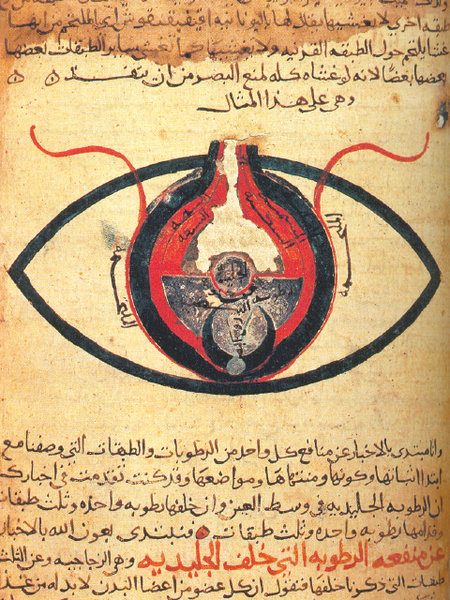
The scholar al-Safadi described two ways to translate: word for word, and meaning for meaning. He put Hunayn, the great translator of Galen, in the second camp. Tarjum translates the same way.
The eye, after Hunayn’s description, about 1200. Public domain.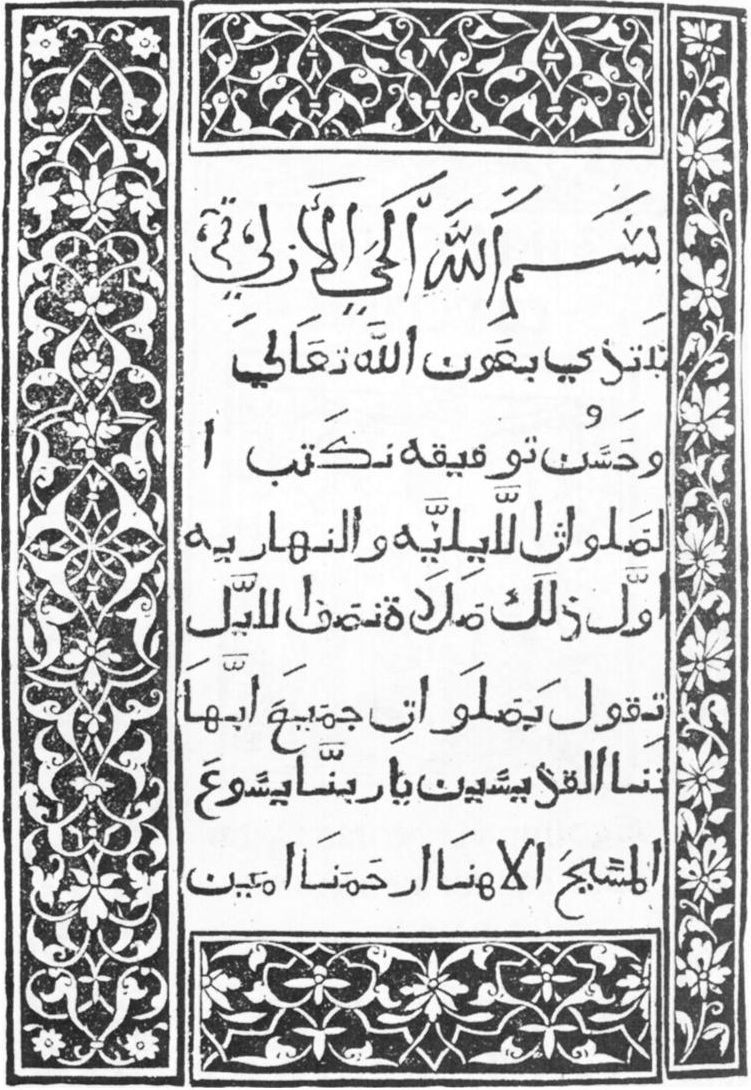
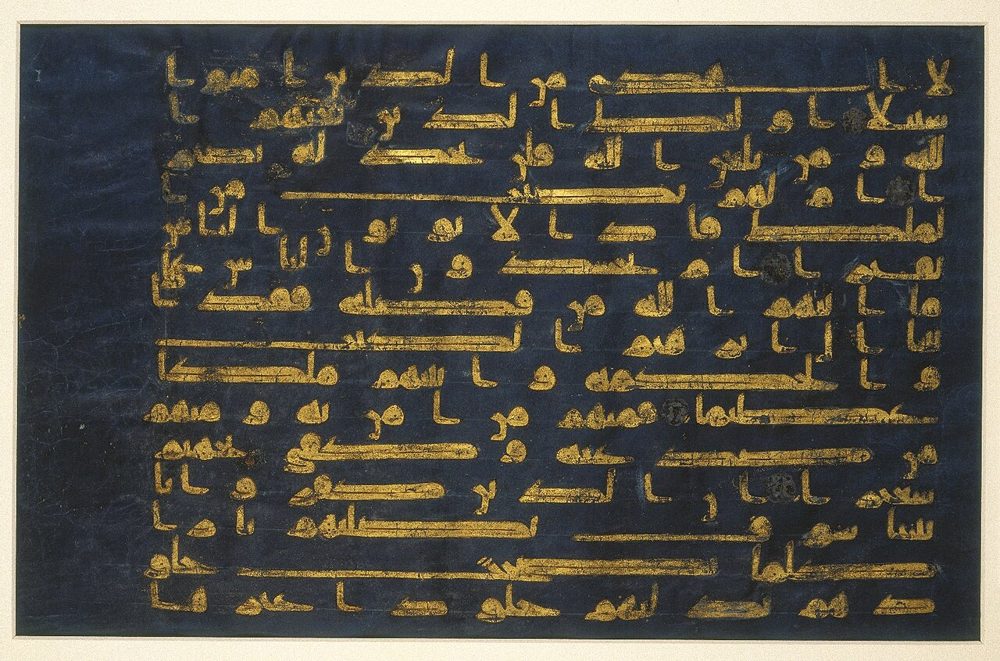
A book of hours and the first known book printed in Arabic with movable type. Its colophon names Fano, Italy, as the place of printing, though some scholars argue it was printed in Venice.
Public domain.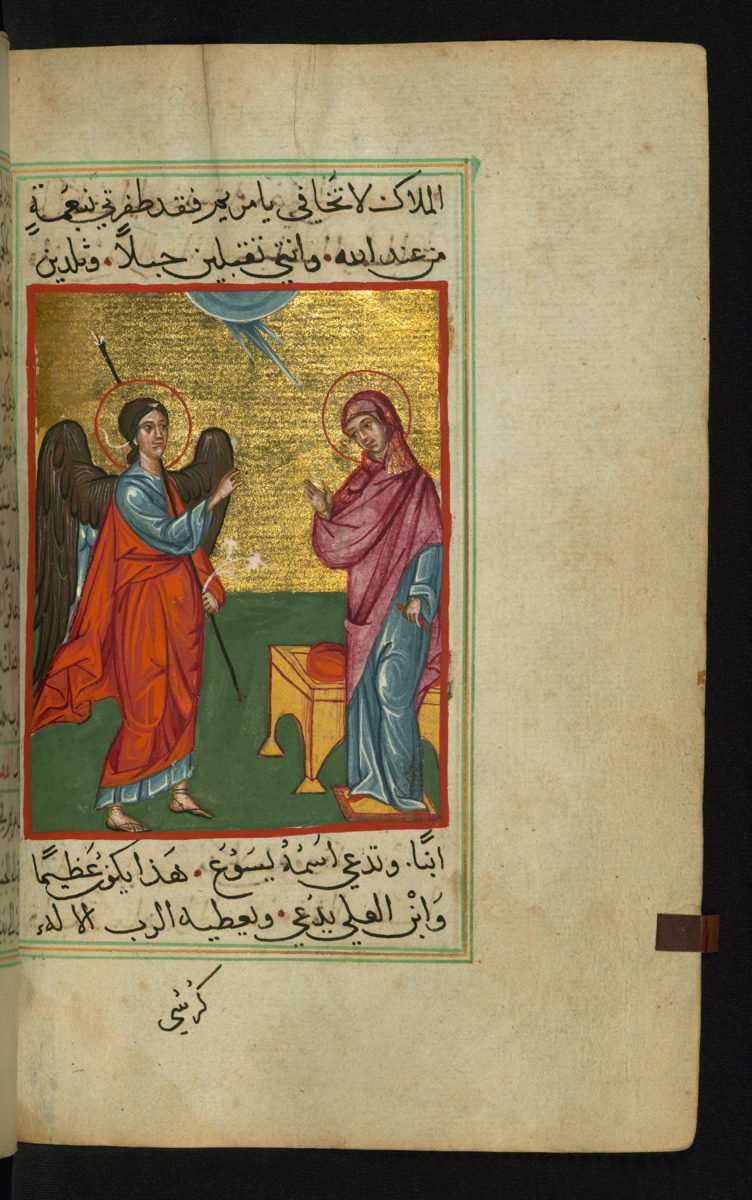
A new Arabic translation of the Bible, made in Beirut between 1847 and 1865 by Eli Smith, Cornelius Van Dyck and their Arab colleagues, and still read today.
Image: Arabic Gospels, Walters Art Museum W.592. CC0.A book is more than its running text. Here, figures, tables, equations and quotations stay part of the translation.
Tarjum does not paste a rough layer of translated labels over the original. It redraws the figure with the new language’s words, digits and direction, from Arabic into English and from English into Arabic.
An illustration made for this page. Real figures appear in the full chapter once it has run.
A table stays a table and an equation stays an equation, with its number and its tie to the text. In Arabic the table runs from the right and can take Eastern Arabic digits, as here.
| العنصر | الرمز | العدد الذري |
|---|---|---|
| هيدروجين | H | ١ |
| أكسجين | O | ٨ |
E = mc2 (٣)
The columns read Element, Symbol and Atomic number: hydrogen, H, 1, and oxygen, O, 8. The equation is number 3.
Each page keeps the habits and the reading direction of its language: Arabic from the right, English from the left.
When an English book quotes the Bible, the verse is not re-translated from the English quotation: it returns in the Arabic Bible’s own wording, with its reference, and your reviewer sees it before deciding. What the author paraphrased stays the author’s words. Checking Quran verses and hadith is coming soon; the Quran and hadith examples below show how it will work.
ٱلرَّبُّ رَاعِيَّ فَلَا يُعْوِزُنِي شَيْءٌ.
Literally: “The Lord is my shepherd, so nothing shall I lack.”
The verse is set in the words of the Bible translation you chose, and keeps its chapter and verse.
فِي ٱلْبَدْءِ كَانَ ٱلْكَلِمَةُ، وَٱلْكَلِمَةُ كَانَ عِنْدَ ٱللهِ، وَكَانَ ٱلْكَلِمَةُ ٱللهَ.
Literally: “In the beginning was the Word, and the Word was with God, and the Word was God”, with “was” in the masculine.
This translation gives “the Word” a masculine verb, and that is how it stays. Nobody corrects it to the feminine.
كما يذكّرنا المرنّم، لا يعوزنا شيء حين يقودنا الرب.
Literally: “As the psalmist reminds us, we lack nothing when the Lord leads us.”
A paraphrase is not swapped for the verse. It stays in the author’s own words.
This works today for Christian books, with the Bible translation you choose. From Arabic into English, the same check works with the English Bible translation you name.
﴿لَا يُكَلِّفُ ٱللَّهُ نَفْسًا إِلَّا وُسْعَهَا﴾
Literally: “God does not charge a soul except with what is within its capacity.”
The verse is not translated back from the English. It returns in its own words, with its place in the Quran.
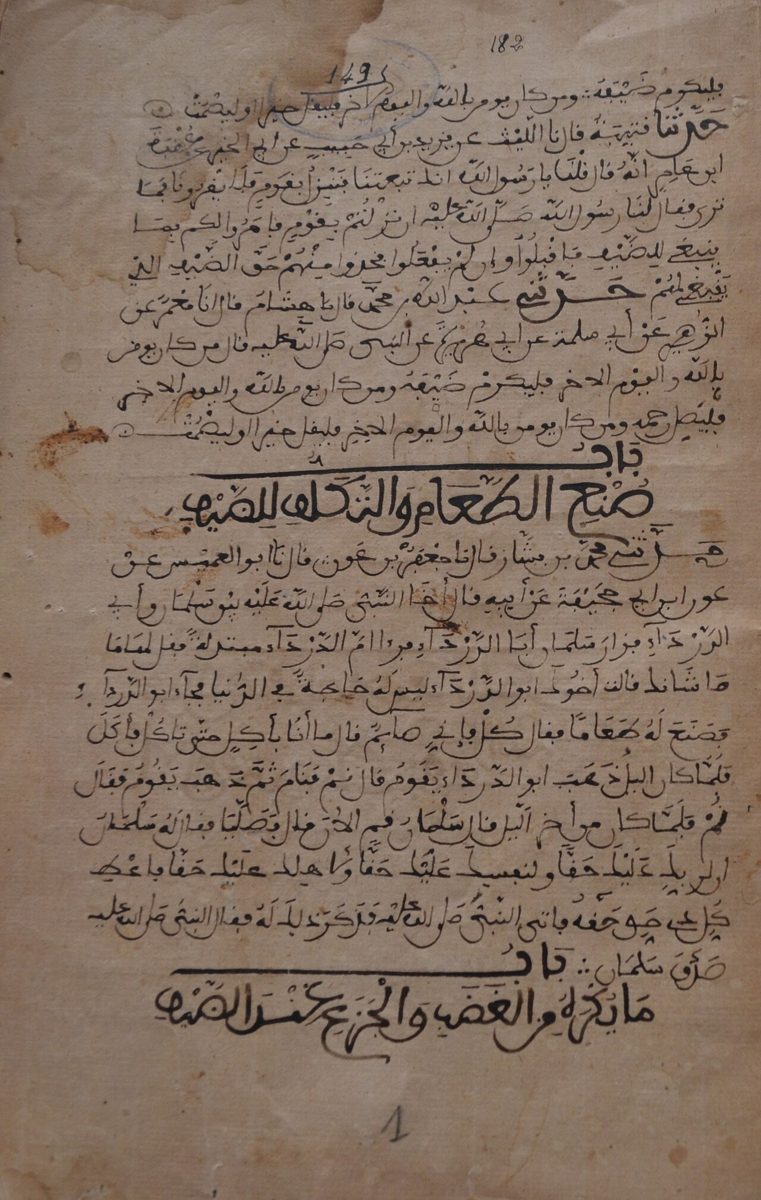
إِنَّمَا الْأَعْمَالُ بِالنِّيَّاتِ، وَإِنَّمَا لِكُلِّ امْرِئٍ مَا نَوَى
Literally: “Actions are only by intentions, and every person shall have only what he intended.”
A hadith comes down in versions whose wording differs, so your reviewer sees what the sources record and chooses. In Sahih Muslim (1907):
إِنَّمَا الأَعْمَالُ بِالنِّيَّةِ وَإِنَّمَا لاِمْرِئٍ مَا نَوَى
Literally: “Actions are only by intention, and a person shall have only what he intended.”
Checking Quran verses and hadith is coming soon to Tarjum; the text here shows what it will do. In a book going from Arabic into English, the verse will keep its own Arabic words, shown with the English translation you choose. We do not offer a new translation of the meanings of the Quran.
The source beside the translation, with the glossary, the memory, word study and an assistant at the sentence you are working on. Try the tools on the highlighted sentence.
Every sentence you approved comes back when it recurs, in this book and across the whole series. Your old memory comes in too, as TMX.
The senses of a word in its context and its dictionaries, with the one closest to the place you are in.
Decide a word once, and it stays that way from the first page to the last. Your existing glossary comes in as TBX.
Years of work in Trados or another tool do not start from zero. Bring your memory, glossary and files, and the next book works from what you already approved.
Importing a memory and a glossary works today for books translated into Arabic. For books translated into English it is coming soon. What comes in can go out: export the memory, the glossary and the files in their formats whenever you like.
A TMX file from Trados or any other tool goes into your organization’s library, and every project reads from it. You set how far to trust what you import.
Your TBX glossary enters the project as proposed terms, and you decide which ones stick.
An XLIFF work file becomes a Tarjum project, with its segments and whatever translation it already holds.
A dictionary in TBX joins the sources you search.
Dictionaries, sources and tools you add when you need them. Each add-on becomes a command in your workspace, and a tool the agent can reach for while it translates.
Arabic and bilingual, opened at the word you stop on.
How a phrase was translated in published bilingual texts.
Vowel marks for Arabic text, and a clean-up for Arabic that came out of a file garbled.
Self-review, other ways to phrase a sentence, and the translation engine you prefer, on your own key.
Missing something? Suggest an add-on, or import your dictionary.
You decide. The proofreader, the subject or religious reviewer, the author and the rights holder each open the book as pages, the way it will print, and record their decision under their own name.
Stevenson: “…and though he enjoyed the theatre, had not crossed the doors of one for twenty years.”
For translators, authors and small teams. Upload your text now, its hardest pages included, and judge the result for yourself.
For publishers, universities and institutions. We start with a book you choose, and agree on the translation, the review and the layout.
On Tarjum, a 250-page book starts at $19 for a month. That covers translation, editing, polishing and layout. Human review stays in your hands, or ours.
Source: Industry Arabic’s rate guide, read on 4 November 2026: 16 to 23 cents a word for large or ongoing projects, on a book of 62,500 words at 250 words a page. The agency delivers a finished human translation, so the two prices buy different things.
Work out what your book costsIt can give you the gist of a short chapter. A book that will be published needs the same name and term in every chapter, a review, and a file a printer accepts. Compare the passages above for yourself. Tarjum’s first 10,000 words are free, so judge it on your own text.
Both. The trial lets you work on the book yourself. If you would rather we take the book on with you, write to us and we will agree on translation, review and layout.
Yes. The machine writes the draft. The decision belongs to a person you choose, or one we choose with you, and it is recorded under their name before publication.
Our terms say: “You keep all your rights in the books and files you upload, and in the translations you make.”
For a book still in copyright, yes: the right to publish a translation belongs to the rights holder, usually the original publisher or the author’s agent. A book in the public domain needs no permission. Tarjum translates the file you upload and does not clear rights on your behalf.
Yes, for books translated into Arabic: import the translation memory as TMX into your organization’s library, the glossary as TBX and work files as XLIFF, and export all of them whenever you like. Import for books translated into English is coming soon.
Not as a paperback: KDP does not print Arabic today. Tarjum prepares the print PDF for a printer or a print-on-demand service that prints Arabic, and the EPUB for ebook stores.
Try it on your own text now, or tell us about the book and we will get back to you.
14 days and 10,000 words, no card needed.