Anyone who has been through translating a full book, whether a literary novel, an intellectual study, or a scholarly reference, knows for certain that translating books differs radically from translating press articles or short marketing texts.
A book is an integrated living being: a term on the first page must stay fixed on the last page after three hundred pages; a character who speaks in an ironic tone in chapter three must not suddenly flip into a preaching style in chapter ten; and numbers, tables, and footnotes must settle in their places without spoiling the printed page's layout.
Most common translation and AI tools on the internet are designed to treat texts as "scattered sentences" in a chat window. You throw a chapter at it and a translation comes out, but the moment you move to the next chapter, the model forgets everything the team agreed on: it names the hero differently, fonts interfere, and editorial chaos begins!
How is the lifecycle of a real book built?
In step with this development, we at "Tarjum" started from a simple question: how do we build a complete workflow centered on the book as a printed entity, from the first page to the final delivery file?
The difference starts from the unit of work itself: ordinary tools treat the file as separate segments, while "Tarjum" treats the whole book as one entity, and that is the real leap:
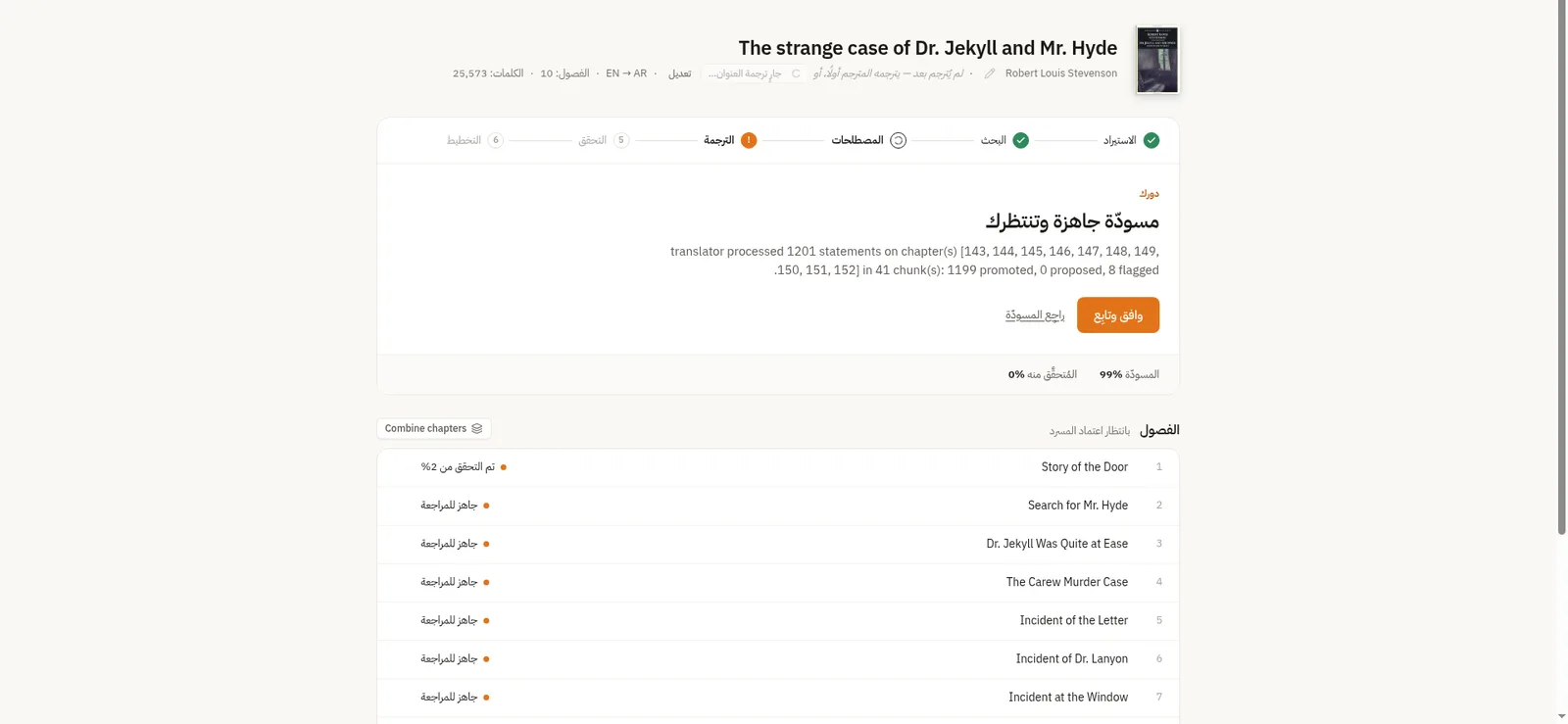
Reading the manuscript and building the glossary: before a single word is translated, the whole manuscript passes through an analysis that extracts the network of names and recurring terms, creating a "binding glossary" that governs the book from first page to last, not file by file as ordinary tools do.
Smart segmentation and preserving the book's context: the book is divided into chapters and scenes that preserve the narrative flow, with the book's cumulative context recalled at every segment, instead of giant context windows in whose middle the details get lost.
Sanctity of approved segments: any segment the translator reviews or edits by hand keeps his decision as the final reference; no line is approved for publication without the translator's and his team's consent, and human review stands above any automated update.
Press-ready output: the work does not end at a raw text file that needs months of typesetting; the book comes out ready for the press directly: right-to-left Arabic direction set, codes isolated so they do not corrupt the page, and page numbers in order, so the delivery file arrives ready with no extra formatting stage.
Real technology is not what tries to replace the writer's and translator's mind, but what lifts from their shoulders the toil of formatting and repeated errors, so that the Arabic book finally receives, in readers' hands, the dignity and splendor it deserves.
If there is a book on your desk waiting for translation, start with it on "Tarjum" and follow its journey from manuscript to press file yourself.
Comments (0)