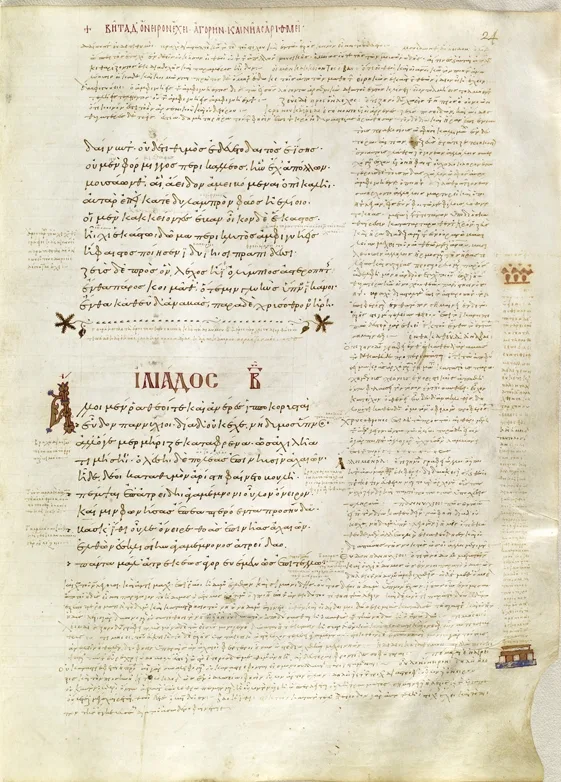
Every literary text carries its own challenges in translation, but classical epic poetry remains the hardest and harshest of them all. The translator here does not merely move words and phrases; he faces a whole civilizational system in which myths intertwine with human emotions: divine intrigues, war speeches, genealogies, and extended similes, and he must preserve the text's dignity and eloquence in an entirely different language.
For more than a century, Homer's Iliad, specifically its second canto, has remained the text on which the claims of many modern language systems break, to this day.
Over a full century, three of the great Arab translators took up this historical challenge, leaving us three different paths that tell the philosophy of literary translation at its finest:
1. Suleiman al-Boustani.. versifying the Iliad in Arabic meters
The Lebanese man of letters Suleiman al-Boustani sat for long years not to translate prose, but to render the entire Iliad in rhymed verse on the meters of al-Khalil! Al-Boustani summoned the grandeur of the pre-Islamic odes and the solid language of Imru' al-Qais and Tarafa to create his poetic miracle, rivaling the Homeric magic in weight and music, convinced that poetry can only be carried by poetry.
2. Amin Salama.. academic precision from the original Greek
Then came Dr. Amin Salama, armed with ancient Greek in its original form, to give the Arabic library a direct philological academic translation from the Greek source. Salama pursued strict scholarly fidelity and rendered the compound Homeric epithets in full, without liberties (such as "winged words," "those with flowing hair," "the city of wide streets"), giving the reader and the researcher the most accurate classical textual document.
3. Drini Khashba.. smooth narrative prose that reaches the ordinary reader
As for the man of letters Drini Khashba, he took a third path: he cast the Iliad in free narrative, novelistic prose, sacrificing some of the constraints of literalness for the magic of flow and smooth storytelling, so that the Greek myth reaches the heart of the ordinary Arab reader and captivates him without the strain of academic complexity.
And what happened when AI entered?
With the rise of large language models, many wondered: can the machine today understand this epic dignity? Practical experience has shown that general models translate the epic as if it were a quick news report; they mix up names and waver in spelling them (Agamemnon one time, Aghamemnon another), and they use colloquial phrases that break the scene's majesty.
Here the real difference of specialized systems like "Tarjum" appeared: they do not leave the engine to improvise the tone, but bind it with verified glossaries that guarantee the solidity of heritage wording (such as choosing "al-tamm" for the royal swan, "ha'iq" for befalling calamity, and "afhaj al-saqayn" for Thersites' ugliness).
Literary translation is not a mechanical equation that replaces a word with a word; it is a spirit summoned and a refined aesthetic taste that the translator chooses with his mind and heart. The machine may lift from our shoulders the toil of writing first drafts, but the epic spirit will always remain a purely human secret.
If you have an old literary text or a public-domain book, upload it to "Tarjum" and watch how it handles it yourself; experience is the best proof.
Comments (0)