
In brief
Clumsiness exposes itself at once, but "deceptive fluency" crafts elegant Arabic prose that may have inverted the source's meaning entirely.
The decisive review question is not: does the translation read naturally? It is: does it say what the source says, with nothing added and nothing missing?
Professional review today is "mirror matching": source and translation side by side, tracking negation particles, numbers and pronouns word by word.
Beauty in translation is a vehicle for meaning, not a substitute for it.
What is deceptive fluency?
When any of us reads a clumsy, disjointed translation, we recoil immediately; clumsiness is an overt error that exposes itself and pushes the reader or editor to stop reading and go back to the source to fix the problem.
But what happens when you fall into the trap of the "deceptively smooth text"?
With the current revolution in generative language models, a silent beast has emerged in translation known as "deceptive fluency." A language model today can craft an Arabic paragraph of supreme beauty and grace, its words flowing like sweet verse, entirely free of grammatical or spelling errors.
But when you place that gleaming paragraph against the original foreign text, you are in for a shock:
The model dropped a crucial negation particle that flipped the meaning of the statement entirely!
Or it replaced a qualified conditional sentence with an absolute one that changed the writer's commitment.
Or it altered a decisive percentage in a scientific study while phrasing the sentence in catchy journalistic style.
Fluency does not mean fidelity
Before we go into the details, let us pause at a point where many who deal with translation for the first time fall. When you read a smoothly translated text, your mind relaxes automatically and assumes that what you hold is an accurate translation; the mind tends to link beauty of phrasing with correctness of meaning. This is the most common mistake in judging translations, and it is exactly what "deceptive fluency" exploits: a smooth text may in fact be a text that betrays its source par excellence.
To make this concrete, consider a simple example of the difference between partial and total negation:
The English sentence "Not all the findings were confirmed" tells us that at least one finding was not confirmed, but on its own it does not say whether some findings were confirmed or none were.
"None of the findings were confirmed," by contrast, is a stronger claim: not a single finding was confirmed. Replacing the first with the second adds information the source never gave, even if the resulting sentence sounds eloquent and confident. That is why it is not enough to ask: does the translation read naturally? We must also ask: does it say what the source says, without adding to it?
How do reviewers protect themselves and readers?
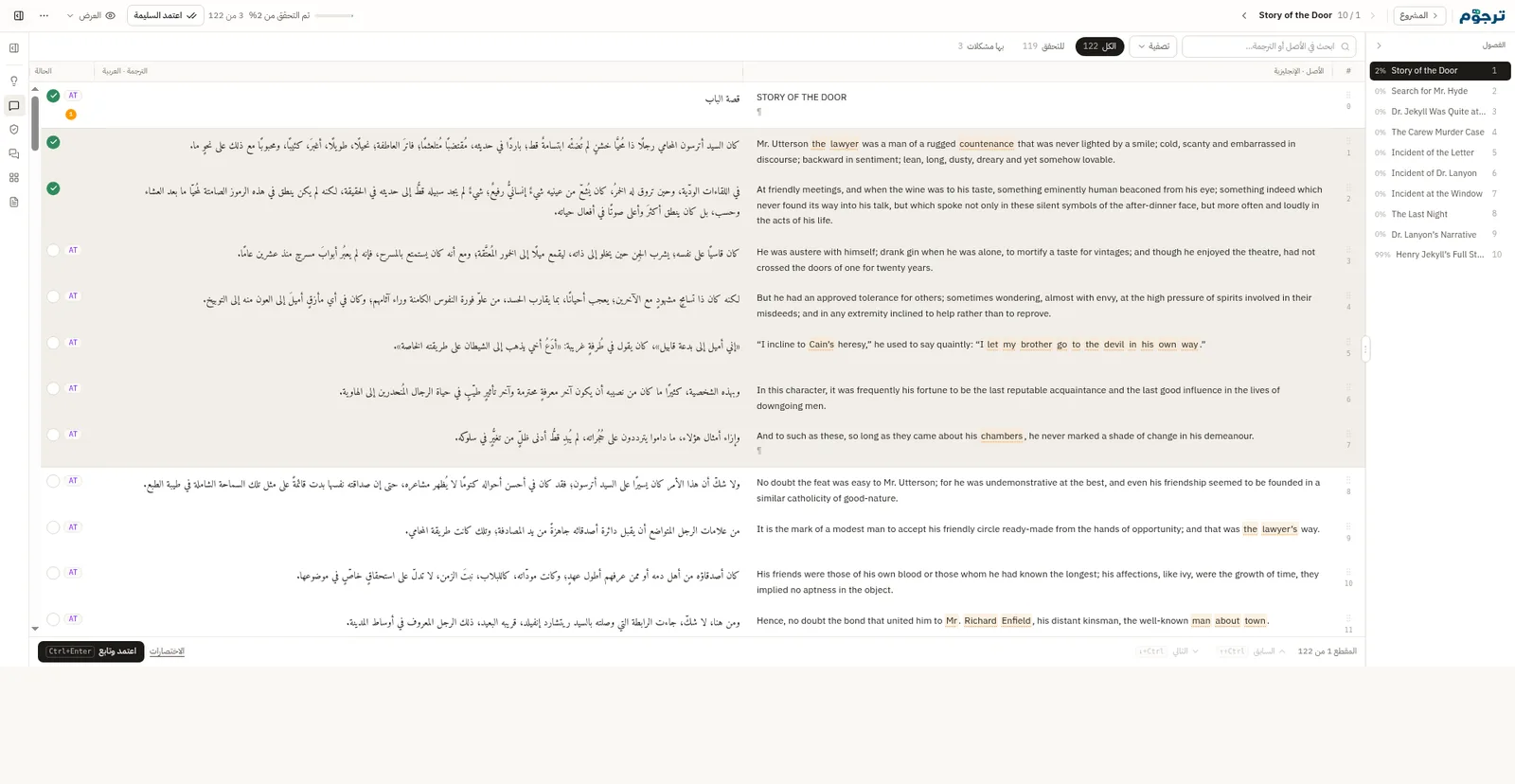
In the past, the reviewer relied on reading the Arabic draft alone and went back to the source only when in doubt; that was a tiring, error-prone method, because the eye does not catch what it does not suspect. Today, the language reviewer's job is no longer reading the Arabic text and enjoying its beauty; professional review has become a precise "mirror-matching" process in which the two texts stand face to face:
Place the source and the translation side by side in one screen and match them segment by segment, instead of jumping between two files.
Track negation particles, numbers, percentages and pronouns word by word, making sure every number in the translation is the same number in the source.
Distinguish clearly between a translation that needs stylistic improvement and a wrong translation that carries incorrect information in beautiful language; the first is a matter of taste that needs better phrasing, the second is an error of meaning that must be fixed at once.
This is where Tarjum's mirror editor comes in: instead of opening two files and getting lost between them, it places the source and the translation in front of you in one screen, highlights terms and segment-approval marks, shortens matching time, and reduces the errors that escape the naked eye.
Check meaning first.. then polish style
Now that we know what mirror review looks like, the practical question remains: where do you start when facing two adjacent texts? The rule is simple: settle the meaning first, then worry about style. Start by reading the source passage and identify what the writer affirms and what he denies; then read the translation and ask yourself: did it widen the claim or narrow it? The words may stay close while the scope of a negation or a condition changes; so record the point of difference before you rephrase, lest the problem disappear behind a more beautiful sentence.
On the next pass, stop at the details that deceive the eye: numbers and their units, percentages, names of people and organizations, and pronoun references. It is not enough to find the number in its place; match its value, its unit, and what it refers to. With every pronoun, name its referent in your mind before moving to the next sentence.
When the meaning is settled, return to style. A translation can be faithful but heavy, or beautiful but unfaithful; separating the two questions shows you exactly what to fix: an error in information or a weakness in expression. Then read the revised sentence together with its source one last time, not on its own.
These steps are not a recipe that cancels professional judgment; they only reorder your attention: settle the meaning first, then improve the way it is conveyed. An editor that displays the two texts side by side eases that comparison, but it does not decide fidelity on your behalf.
Conclusion
Beauty in translation is a vehicle for meaning, not a substitute for it. An honest, sober text will always remain nobler and more enduring than dazzling fluency that sells illusion to readers.
And if you want to see the difference yourself, upload a translated text to Tarjum and compare it with the source line by line; direct comparison is the truest evidence.
Comments (0)